
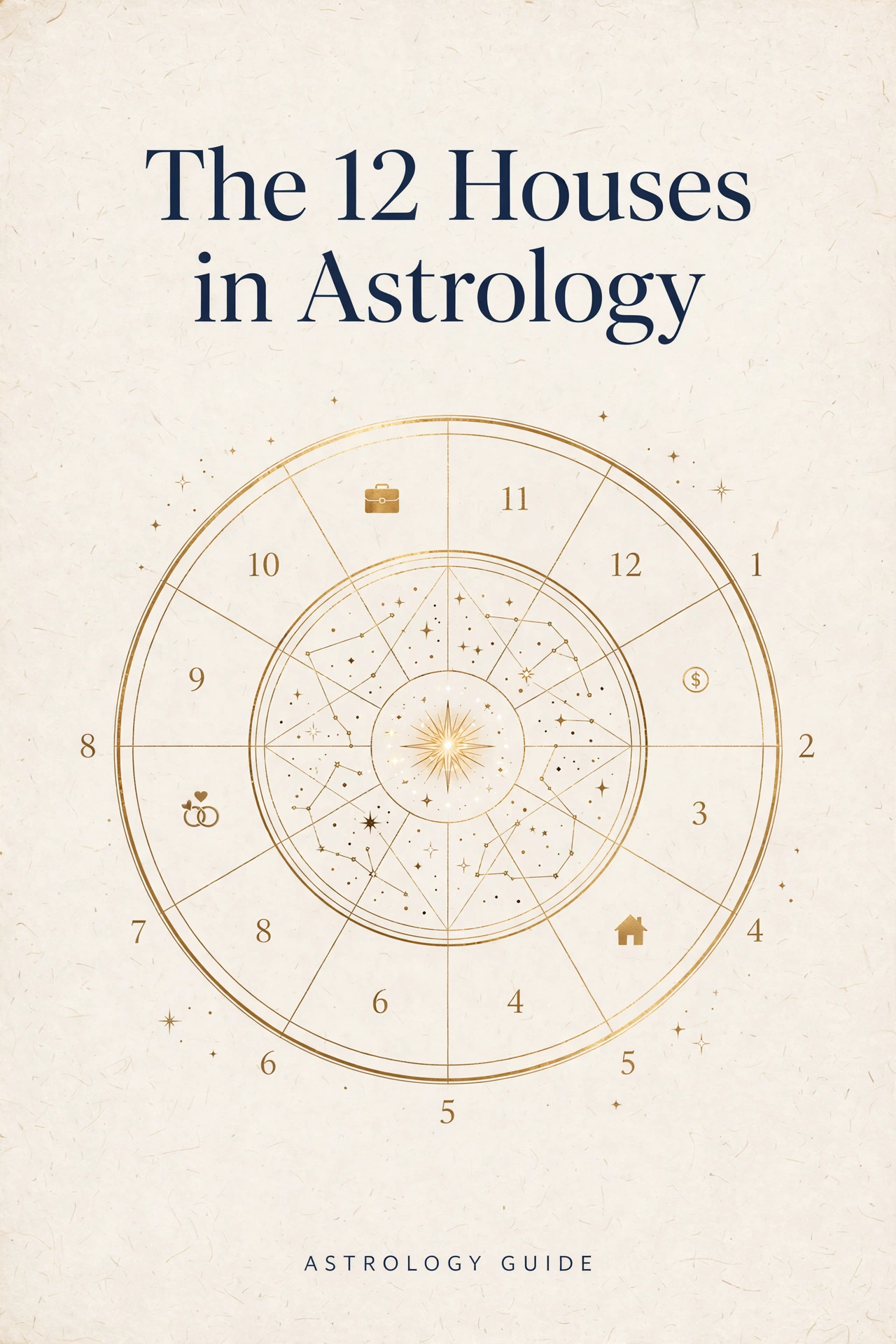
The planets in your birth chart reveal what you express, the signs show how you experience life, while the houses indicate in which area this energy manifests in your life. For instance, the Mercury-Aries combination in the 3rd house suggests a quick and assertive communication style, whereas in the 10th house, it might translate into a direct and bold career language. In this article, we discuss the 12 houses of astrology individually along with their real-life correspondences.
What Do Houses Mean?
The rotation of the Earth around its axis at the time of your birth divides the sky into 12 segments based on where you were born; these segments are called houses. Signs answer the “how”, planets answer the “what”, and houses answer the “where”. For example, Venus reflects your values of love and aesthetics (what), the sign it occupies reflects your expression style (how), and the house it resides in shows in which area of your life this energy shines (where).
- Angular Houses (1, 4, 7, 10): The four main pillars of the chart such as identity, family, relationships, and career; generally read as the strongest and most decisive houses.
- Fixed Houses (2, 5, 8, 11): Indicate how you maintain and safeguard your resources, values, and gains.
- Mutable Houses (3, 6, 9, 12): Relate to learning, adaptation, and transformation processes.
The absence of a planet in a house does not imply that area is “missing” in your chart; the condition of the sign and the ruling planet of that house still conveys a lot about that life area.
From the 1st House to the 12th House: A Guide to Life Areas
1st House — Identity and First Impressions
This house, where the Ascendant is located, is your “face” to the world: physical appearance, first impressions, demeanor, and approach to new beginnings. The planets here are directly felt in your personality and appearance; the 1st house also describes how you “enter” life, as well as your entrepreneurial spirit and self-awareness level.
2nd House — Money, Values, and Self-Worth
This house is about the money you earn, your movable possessions (excluding your home), and what you perceive as “valuable”. Here you read not only material security but also confidence in talents, knowledge, or beliefs. It should not be confused with the 8th house: the 2nd house concerns your own resources, while the 8th house relates to shared or others’ resources.
3rd House — Communication and Local Environment
Talking, writing, daily thought patterns, early education, siblings, and short trips fall under this house’s domain. In contrast to the 9th house’s effort to see the “big picture”, the 3rd house relates to immediate perception, collecting details, and connections with the local environment.
4th House — Home, Family, and Roots
This house, located at the bottom point of the chart, represents the family you were born into, the atmosphere of your childhood home, and your sense of inner security. It shows where your emotional foundation comes from and when you feel you have “returned home” to yourself.
5th House — Creativity, Love, and Children
Self-expression, dating, romance, hobbies, and willingness to take risks are gathered here. Since marriage is the topic of the 7th house, the 5th house is more about “heart-opening” short-lived or passionate experiences. Children are also connected to this house, both in the literal and metaphorical sense (students, projects).
6th House — Daily Work, Routine, and Health
This house covers working conditions, daily habits, hygiene, and healthcare. You can also read about employer-employee relationships, how you serve, and how you take care of your body here — unlike the grand career goals of the 10th house, this is the practical flow of the day.
7th House — Partnerships and Marriage
This house, located directly opposite the Ascendant, covers marriage, business partnerships, contracts, and — traditionally — open enemies. The 7th house often teaches us something about ourselves through “others”: recurring patterns in relationships often reflect back to our own chart.
8th House — Shared Resources and Transformation
This house deals with inheritance, joint finances, taxes, sexuality, and deep emotional intimacy. Although it is one of the most misunderstood houses in astrology, its essence is not “death” but transformation: the ending of one thing and the rebirth of another.
9th House — Philosophy, Beliefs, and Long Journeys
This house concerns higher education, religion, law, foreign travels, and the search for meaning in life. The 3rd house represents “information”, while the 9th house represents the “understanding” formed by synthesizing that information — everything that expands your horizon falls under this category.
10th House — Career and Social Reputation
This house, where the MC is located, illustrates professional success, status, and your “public identity” in society. In stark contrast to the private/internal world of the 4th house, the 10th house concerns outward success and recognition.
11th House — Friendships and Community
This house gathers your social circle, friend groups, long-term hopes, and common goals. While the 5th house represents individual creativity, the 11th house describes how that expression takes shape through a group or community.
12th House — Subconscious and Introspection
The final house of the chart; it relates to dreams, the subconscious, the need for solitude, and spiritual introspection. While often interpreted as “loss” or “isolation”, its main theme is to transcend the ego and reconnect with a larger whole — a natural space for meditation, therapy, and inner work.
What to Pay Attention to When Interpreting Houses?
- Planets in the House: If there is a planet in a house, its nature manifests directly in that life area.
- Sign on the House Cusp: Even without planets, the sign marking the beginning of the house explains how you approach that area.
- House Ruler: The position of the planet that rules a house in the chart relates the theme of that house to another life area.
- Opposite Houses: Each house creates a polarity with its opposite house (1-7, 2-8, 3-9, 4-10, 5-11, 6-12) — one complements the other.
The system of houses bridges the birth chart, transforming it from abstract symbols to real life, meaning your career, relationships, and daily habits. If you’re new to reading your birth chart, it’s most reliable to clarify your Ascendant and 1st house first, and then move on to the other houses.
Bir yanıt yazın
Yorum yapabilmek için oturum açmalısınız.