
Introduction: Why are the angles in the chart important?
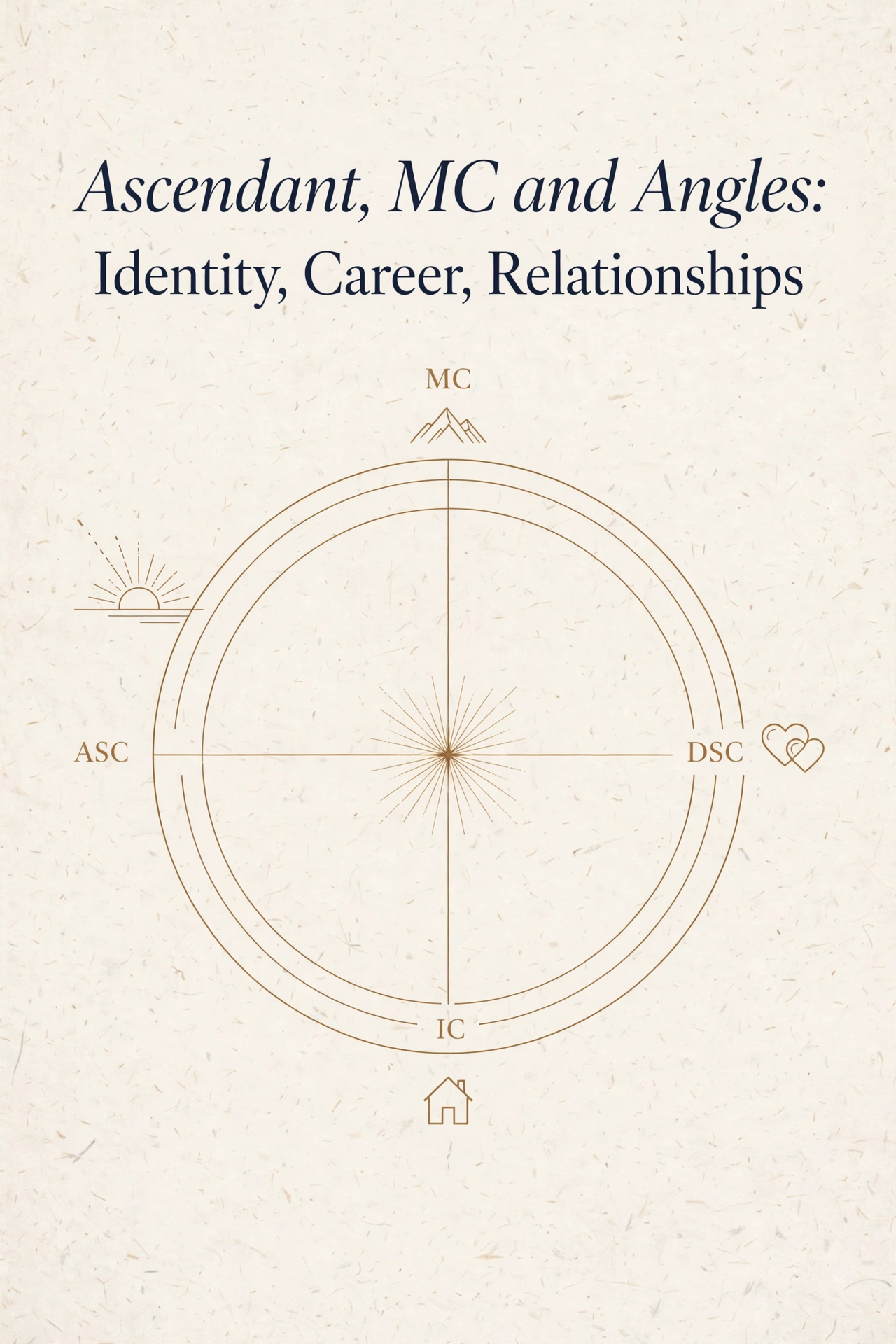
\nThe birth chart is not just a personality blueprint of the planets; it also includes four fundamental angles and axes. The Ascendant, Midheaven (MC), Imum Coeli (IC), and Descendant (DSC) provide us a map of both our inner world and how we tend to present ourselves outwardly. In this article, you will learn what these main points symbolize, their positions in the chart, and practical ways to interpret them.
\nAscendant: How do you perceive the world?
\nAscendant is the zodiac sign rising on the eastern horizon at the moment of your birth. It symbolizes the outward expression of your personality, your first contact with the environment, and your approach to life. In other words, it determines how you “think” about the world and how you react to it.
\nThe Ascendant is not just a style; it is also like a perception filter. For example:
\n- \n
- Aries Ascendant sees the world as a place that requires action and decisions; sudden moves and a tendency to take initiative are common. \n
- Gemini Ascendant tries to solve the world through acquiring knowledge and communication; curiosity and variety gain importance. \n
Planets close to the Ascendant or 1st house cusp can be related to your birth experience and the nature of the birth; for example, Saturn or Capricorn Ascendants may indicate more challenging or delayed beginnings. This angle also determines how a person tends to “come out” into the world.
\nMidheaven (MC) and Imum Coeli (IC): The outer world and origins
\nMC (Midheaven) relates to where you want to reach in the outer world, your career, reputation, and your standing in society. MC symbolizes the individual’s social integration, authority relationships, and professional orientation. It serves as a “roadmap” for your life: what mark do you want to leave in society?
\nIC (Imum Coeli) is located directly opposite the MC, at the lowest point of the chart. It defines the areas of home, roots, family environment, and emotional security. It addresses inner integration, personal psychological matrix, and early family influences.
\nThe MC-IC axis bridges the family atmosphere and professional orientation: while the IC connects you to your roots, the MC determines how you open up from that foundation. The placements of the Sun, planets, and signs enrich the expression of these two points.
\nGeneral tendencies of the MC according to the signs (short examples):
\n- \n
- MC Aries: A competitive, pioneering path seeking personal success. \n
- MC Taurus: Financial and material security, ambitious and productive work. \n
- MC Gemini: Visibility through communication, variability, and mental activity. \n
- MC Cancer: A nurturing, emotional career pursuit; “motherly” themes. \n
- MC Leo: Visibility, creativity, and a desire for the spotlight. \n
- MC Virgo: A pursuit of service, order, and meticulous contributions. \n
- MC Libra: Status through cooperation, aesthetics, and partnerships. \n
- MC Scorpio: Pursuits of intensity, empowerment, and transformation. \n
In a daily context, for example, during annual solar returns, the MC indicates the goals and career focuses for that year; it can also show potential changes in family hierarchy or personal authority.
\nDescendant (DSC) and the 7th House: Mirrors established with “others”
\nDescendant (western horizon) is directly opposite the Ascendant and marks the beginning of the 7th house. This point shows how we relate to the type of person that appears in close relationships and equality-based partnerships. In other words, it is key to understanding not so much who you marry, but how reflections are cast in relationships.
\nKey points:
\n- \n
- The seventh house deals with relationships, marriage, and partnerships; here, two people face each other equally. \n
- Descendant symbolizes the compromises, concessions, and adjustments needed in relationships. \n
- If the ruler of your chart (the ruler of the Ascendant) is in the 7th house, your tendency to explore your identity and who you are through relationships is strengthened. \n
This axis also shows how the roles established with parents in childhood are carried into adult relationships; the Ascendant-Descendant axis is the stage on which we build our individual identity in relation to a partner.
\nPractical steps for a comprehensive reading
\n- \n
- First glance: Find the Asc, MC, IC, and DSC angles in the chart. In which signs do they reside? Which planets are in aspect or nearby? \n
- Sign language: Note the basic tendencies of each angle according to its sign (e.g., MC Aries = initiative, MC Libra = relationship-focused career). \n
- Evaluate the planets: What qualities do planets near these points or making aspects bring? Aspects indicate abilities or challenges. \n
- Look at the axes: The Asc-DSC axis shows your roles and learning areas in relationships; the MC-IC axis shows how you balance outer success with inner security. \n
- Integrate: Do not decide based on a single point; consider professional and material indicators such as the 2nd, 6th, 9th, and 10th houses as well. \n
Tip: See the Ascendant as a filter — it is very close to you, and sometimes we may not notice it. The energy of the Descendant and the 7th house is easily sought outside because we think it belongs to “others”; however, turning around to see what is reflected in ourselves brings transformation.\n
Summary / Key Points
\n- \n
- Ascendant (ASC) shows how you perceive the world and how you reflect outward; it may be related to the birth experience. \n
- Midheaven (MC) symbolizes your career, reputation, and goals within society; it establishes the dynamic between roots and direction with the IC. \n
- Imum Coeli (IC) is the area of home, origins, and emotional security; it is the matrix of inner integration. \n
- Descendant (DSC) and the 7th house show the projection of individuality within relationships, compromise, and mirroring processes. \n
- Practical reading: Angles, signs, and planetary placements should be read together; axes complement each other. \n
Being aware of these key points helps you interpret your chart in a more solid manner for self-understanding as well as for relationships and career. Next step: find these four points in your own chart, take brief notes, and observe how they interact with each other.
\n\n
Beginner series – other lessons:
\n- \n
- Fundamental Concepts of Astrology: A Systematic Guide to Understanding the Birth Chart \n
- Zodiac, Elements, and Qualities: The Basic Language of Astrology \n
- Sun and Moon: The Basic Functions of Identity, Emotions, and Motivation in Your Chart \n
- The Meaning of Aspects and Orbs in Astrology: The Right Measure in Chart Interpretation \n
- → Ascendant, MC, and Other Points in the Birth Chart: Identity, Career, and Relationships (this article) \n
- First Chart Reading: Step-by-Step Strategies for Interpreting the Birth Chart \n
Bir yanıt yazın
Yorum yapabilmek için oturum açmalısınız.