
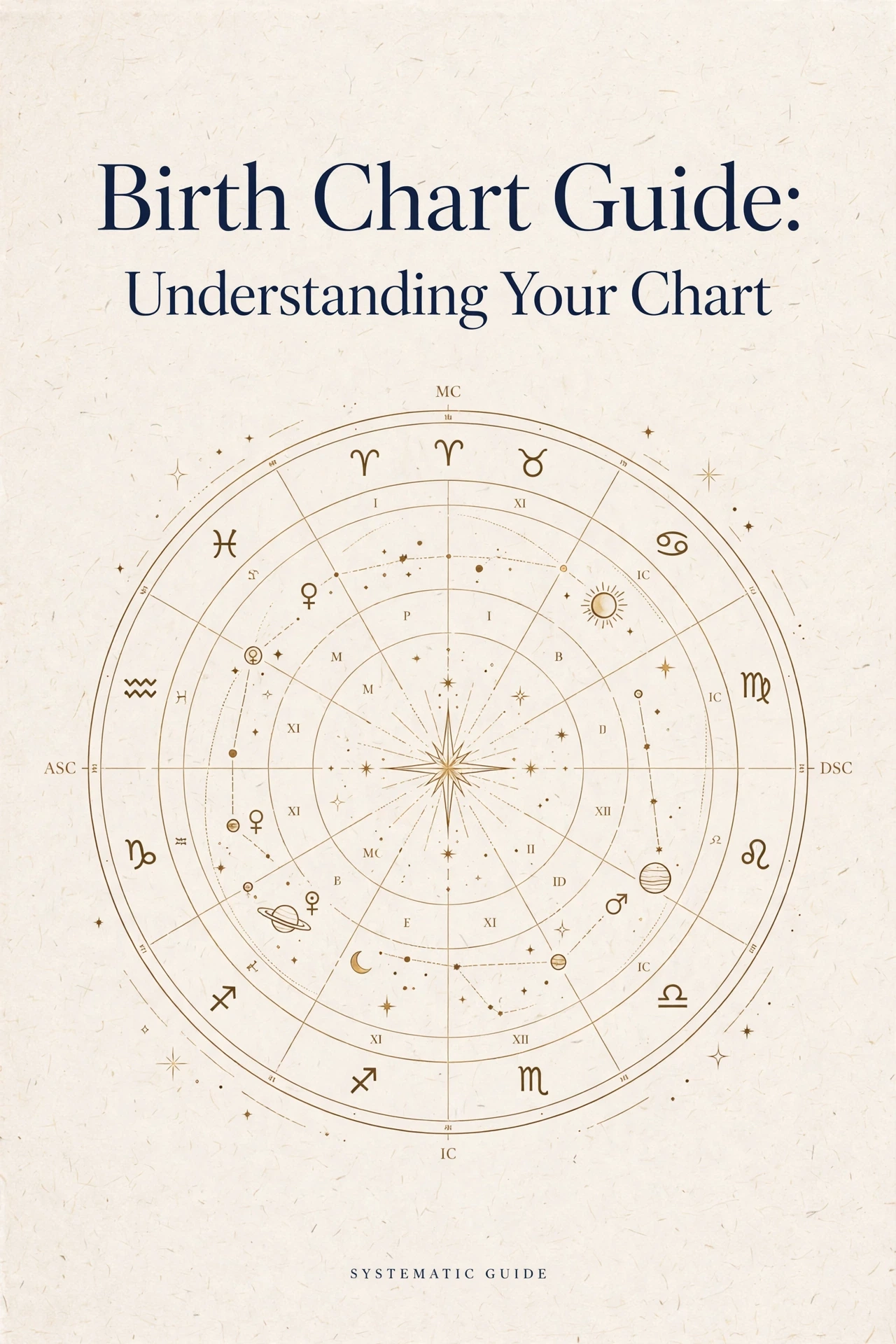
Astrology is the effort to establish a meaningful connection between the patterns of human life and the arrangement of planets in the sky as seen from Earth. Throughout history, the horoscope showing the positions of planets—especially the natal chart at the time of birth—has been the fundamental tool. In this article, you will learn the basic principles of astrology, the components that make up the birth chart, how to start reading a chart systematically and step by step, and the psychological markers of commonly seen chart patterns.
Four Key Components of the Birth Chart
Each birth chart is interpreted through the interaction of four elements. Each of these components asks a different question and together reveals the holistic meaning of the chart.
- Planets and Astrological Points — What to expect? The active forces of the chart are the sources of personality, motivations, and life themes.
- Signs (12 Zodiac Signs) — How to expect? It shows the expression style of each planet, that is, the quality of its energy: through element (fire, earth, air, water) and quality (cardinal, fixed, mutable).
- Houses (12 Houses) — Where to expect? Indicates in which life areas the planets are active: relationships, career, home, etc.
- Aspects — Why to expect? The interactions that planets have with each other explain points of conflict and harmony; they provide clues as to why events occur.
Chart Calculation: What Information is Required?
Three essential pieces of information are needed for an accurate birth chart: date of birth, time of birth, and place of birth. Particularly, the time of birth is critical to determine the Ascendant and the exact placement of houses. Without the rising sign and house placements, the expression of personality and the areas of life influenced by the planets cannot be accurately assessed.
However, useful results can still be obtained with missing information: the zodiac signs in which the planets are located, the balance of elements and qualities, some significant planetary positions, and aspects can still be interpreted. But when certainty is required regarding houses and the Ascendant, obtaining the correct time is crucial.
Planet Method: Sequential, Step-by-Step Interpretation
Instead of trying to interpret the birth chart with all its symbols at once, moving forward with a planet-based linear (sequential) method reduces confusion. This approach simplifies uncovering core themes step-by-step, facilitating synthesis after understanding the parts instead of the whole.
- The Sun — Check which sign it is in: the foundation of core identity. The element and quality of the sign are important.
- The Moon — Emotional nature and inner world; the sign it is in indicates the form of emotional response.
- Ascendant — The starting point for outward expression and lifestyle; assess its harmony with the Sun and Moon.
- Then consider the other planets one by one: combine the psychological archetypes of the planets with the meanings of the signs; check which elements and qualities are predominant.
- Starting from key triplicities like Sun-Moon, Sun-Ascendant, Moon-Ascendant, determine relationships, harmony, and oppositions.
The practical application of this method: summarize each planet in your chart in a few short paragraphs. This way, you can easily see the recurring themes and core archetypes in the chart. Then synthesize with the house system and other corrections (e.g., cultural conditioning or level of spiritual evolution).
Chart Patterns and Psychological Indicators
The distribution of planets on the chart can create specific patterns; these patterns provide strong clues about a person’s energy intensities and psychological tendencies.
- Bundle — The clustering of planets in a third of the chart: narrow interests, limited responses to external stimuli. It also offers potential for self-sufficiency with limited resources.
- Bowl — Planets on one half of the chart, the other half empty: strong internal resources but feeling disconnected from one area of life. Depending on concentration in the lower or upper half, there is a tendency to initiate or complete.
- Bucket — A single distant planet corresponding to the Bowl pattern (handle): this isolated planet adds a special focus or passion that guides the chart; it can play an inspiring or provocative role.
- Tripolar, Tripod, Locomotive, Seesaw — Distributions with three focal points or in two bundles show different balance and dynamism. Tripolar arrangements can generally carry tendencies toward self-sufficiency and balance.
In practice, if you must choose between multiple patterns, a tripolar interpretation may be preferred; because such distributions can highlight the main theme of the chart due to self-sufficient personality structures and strong triplicate ties.
Tip: Without the correct time of birth, rising and house placements cannot be reliably calculated. Nevertheless, planetary placements in signs, element/quality balances, and interplanetary aspects still provide valuable information.
Practical Steps: Quickly Reading a Chart
Initially practicing systematically accelerates learning. Apply the following short guide:
- Take a general look at the chart: note intensities, voids, and striking patterns.
- Identify the basic triplicity by following the order of the Sun, Moon, Ascendant; prioritize element and quality balance.
- Identify strong placements and important aspects; associate these with key keywords.
- When interpreting for an individual, only convey what the chart indicates; if it’s someone you know, avoid biases and validate by getting feedback.
- After each reading, note deficiencies and errors to advance learning; practice rapidly develops with short readings of 15–30 minutes.
Summary / Key Points
- The birth chart fundamentally consists of planets, signs, houses, and aspects; each component answers a different question.
- The correct date, time, and place are important for the accuracy of the chart; particularly, the time is essential for the Ascendant and houses.
- The planet-based sequential method simplifies interpretation: first the Sun, Moon, Ascendant, then other points.
- Chart patterns (Bundle, Bowl, Bucket, tripolar, etc.) give strong signals about a person’s energy intensities and psychological inclinations.
- With practice and feedback, you can develop holistic interpretations by combining symbols and uncovering recurring themes.
This fundamental framework will help you systematically and calmly decipher a birth chart; as you progress, it will be possible to deepen these foundations with the house system, aspects, and finer techniques.
Beginner Series — Other Lessons:
- → Basic Concepts of Astrology: A Systematic Guide to Understanding the Birth Chart (this article)
- Zodiac, Elements, and Qualities: The Fundamental Language of Astrology
- Sun and Moon: The Core Functions of Identity, Emotions, and Motivation in Your Chart
- The Meaning of Aspects and Orbs in Astrology: The Right Measure for Chart Interpretation
- Ascendant, MC, and Other Points in the Birth Chart: Identity, Career, and Relationships
- First Chart Reading: Step-by-Step Strategies for Interpreting the Birth Chart
Bir yanıt yazın
Yorum yapabilmek için oturum açmalısınız.