
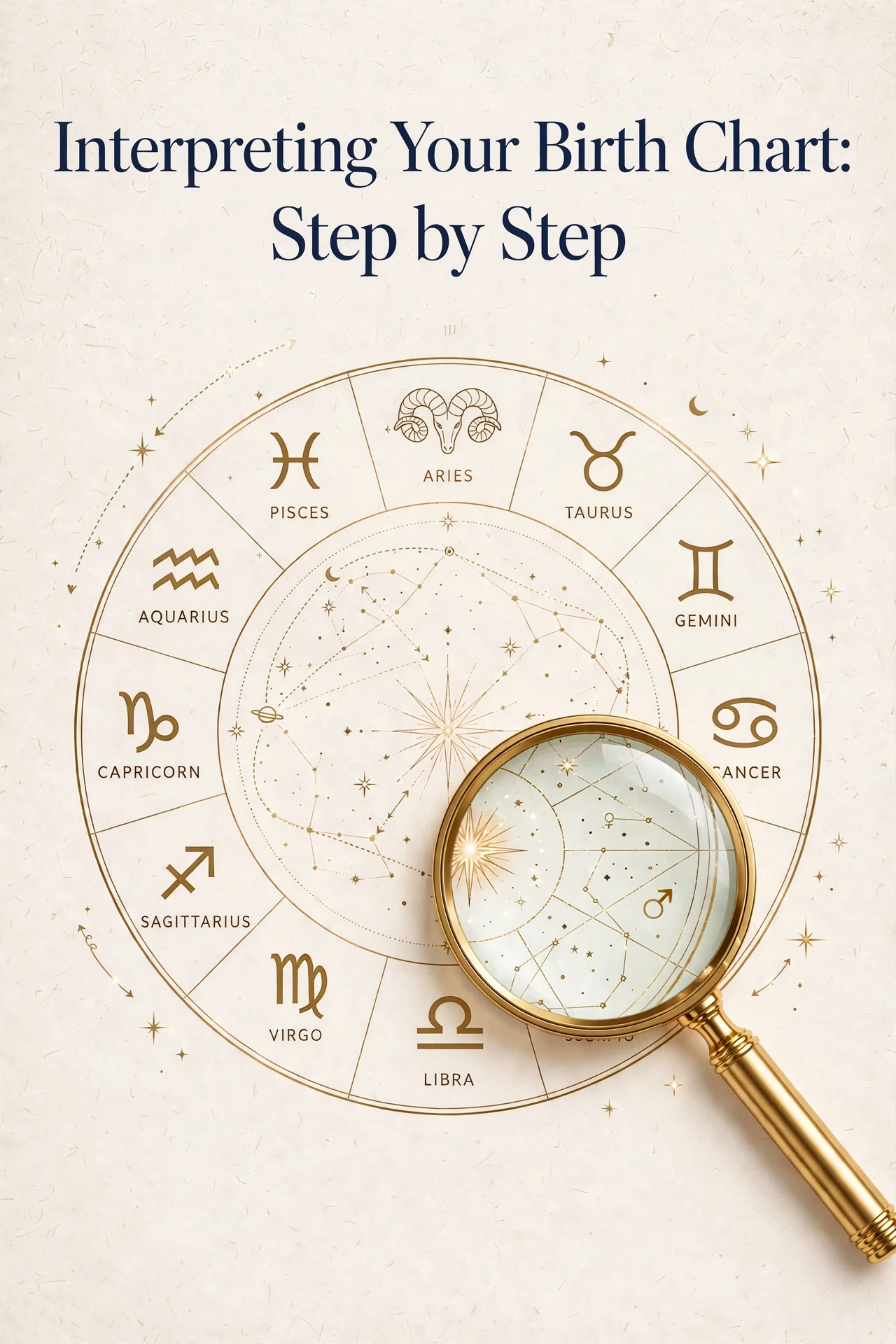
In this guide for beginners who want to learn how to interpret a birth chart, we will proceed step by step. Our priority will be to see the basic structure without getting lost in complex symbols and to develop a holistic understanding.
\n\nWhere to Start Interpretation?
\nThe most practical approach to starting the birth chart interpretation process is to establish a ranking and prioritization system. First, identify the Sun, Moon, and Ascendant points; these represent the core of personality, emotional structure, and outward appearance. Then, examine the distribution of elements and modes; missing or dominant elements highlight personality dynamics.
\n- \n
- To view the chart as a whole, first look at the general balance (elements, modes, hemisphere distribution). \n
- Evaluate personal planets (Sun–Moon–Mercury–Venus–Mars) first; these shape daily behavior and the inner world. \n
- Then move on to social and outer world planets (Jupiter, Saturn, etc.). \n
First Priority: Sun, Moon, and Ascendant
\nThe trio of Sun, Moon, and Ascendant is the backbone of interpretation. The Sun indicates who you are and your life purpose; the Moon reflects your emotions, need for inner security, and early environmental atmosphere; the Ascendant represents how you appear to the world and your first impressions. The relationships between these three (harmony, opposition, or tension) form the main theme of the chart.
\n\nSun
\nThe Sun represents ego, vitality, and purpose. Its function is to provide self-awareness; it shows what you aim for in life and how you expend energy. The sign and house where the Sun is located tell how this energy is directed.
\n\nMoon
\nThe Moon embodies your inner rhythms, habits, and need for security. It is connected to the mother and the early home environment; it reflects automatic emotional responses. The Moon can balance or conflict with the Sun; watch for these combinations.
\n\nAscendant
\nThe Ascendant determines your style of relating to the outer world, your body language, and your life path. Be sure to examine the 1st house of the chart and the ruler of the Ascendant; this reveals the person’s life arena.
\n\nElement and Mode Balance
\nElements (Fire, Earth, Air, Water) and modes (Cardinal, Fixed, Mutable) provide the overall rhythm and energy of the chart. An overabundance or lack of an element can facilitate certain abilities or create difficulties.
\n- \n
- Fire: Initiative, courage, energy. \n
- Earth: Practicality, patience, resource management. \n
- Air: Mental communication, ideas, social connections. \n
- Water: Emotionality, empathy, intuition. \n
A crowded element may have shadows as well as positive aspects; for example, too much Fire can lead to impatience, while too much Water can lead to oversensitivity. Evaluate the style of action (initiating, sustaining, adapting) by looking at the modes.
\n\nHouses and Rulers
\nHouses represent life areas: the 1st house is identity, the 2nd house is resources, the 7th house is relationships, and so on. The house in which a planet resides indicates the area of life in which it is active; the status of the house ruler is also significant. A ruler in another house, in a weak or strong position will nuance the house topic.
\n- \n
- House placements indicate which areas of life are emphasized. \n
- The position and aspects of the house ruler show how house themes are activated. \n
- The distribution of elements/qualities in the houses indicates where balance is needed in life areas. \n
Reading Aspects
\nAspects show the nature of the relationships between planets. An aspect describes how two energies work together or conflict. Key aspects include: conjunction (quick expression), square (tension), trine (flow), opposition (dialectic), sextile (ease).
\n- \n
- Conjunction: Planets merge; energy is intense and works together. \n
- Square: Inner conflict, challenging conditions for growth. \n
- Trine: Natural flow of abilities, supportive expression. \n
- Opposition: Dual relationships and projection areas become evident. \n
When reading aspects, look for both patterns and recurring themes; which planets are frequently interacting, in which life areas are conflicts arising?
\n\nSynthesis: Combining Key Themes
\nSynthesis is the act of piecing together the parts to form the story. The goal here is to find the recurring theme conveyed by the trio of Sun-Moon-Ascendant, the element and mode balance, house placements, and angular patterns together. Identifying recurring archetypes instead of individual symbols helps you understand the chart as a whole.
\nTip: First, write a one-sentence “chart summary.” Then explain each key point (Sun, Moon, Ascendant, dominant element, most significant aspect) in individual paragraphs.\n\n
Practical Tips for Beginners
\nThe most effective path for beginners is regular practice and note-taking. Repeat the same steps for each new chart; this way, you develop a systematic flow. Here’s a handy short list:
\n- \n
- Write the Sun-Moon-Ascendant trio for each chart and create a paragraph for each. \n
- Look at the elements and modes, noting those that are missing/dominant. \n
- Check the planet distribution in the houses and the position of the Ascendant ruler. \n
- Identify the three strongest relationships regarding aspects and explain how they align with the life theme. \n
- Keep it simple: first capture the major themes, delve into details later. \n
Practical exercise: Choose one birth chart each day. Write your initial impression in the first five minutes, then spend 20 minutes analyzing the Sun-Moon-Ascendant and the element/mode distribution. You will feel the difference in a week.
\n\nSummary / Key Points
\nInterpreting a birth chart is learned through a systematic and ordered approach. First, focus on the Sun–Moon–Ascendant, then on elements and modes, followed by houses and rulers; lastly, read the aspects and form the synthesis. Identify recurring themes and summarize each chart with short paragraph-based interpretations. Regular practice and note-taking accelerate success for beginners.
\n\n
Beginner Series — Other Lessons:
\n\n
Bir yanıt yazın
Yorum yapabilmek için oturum açmalısınız.