
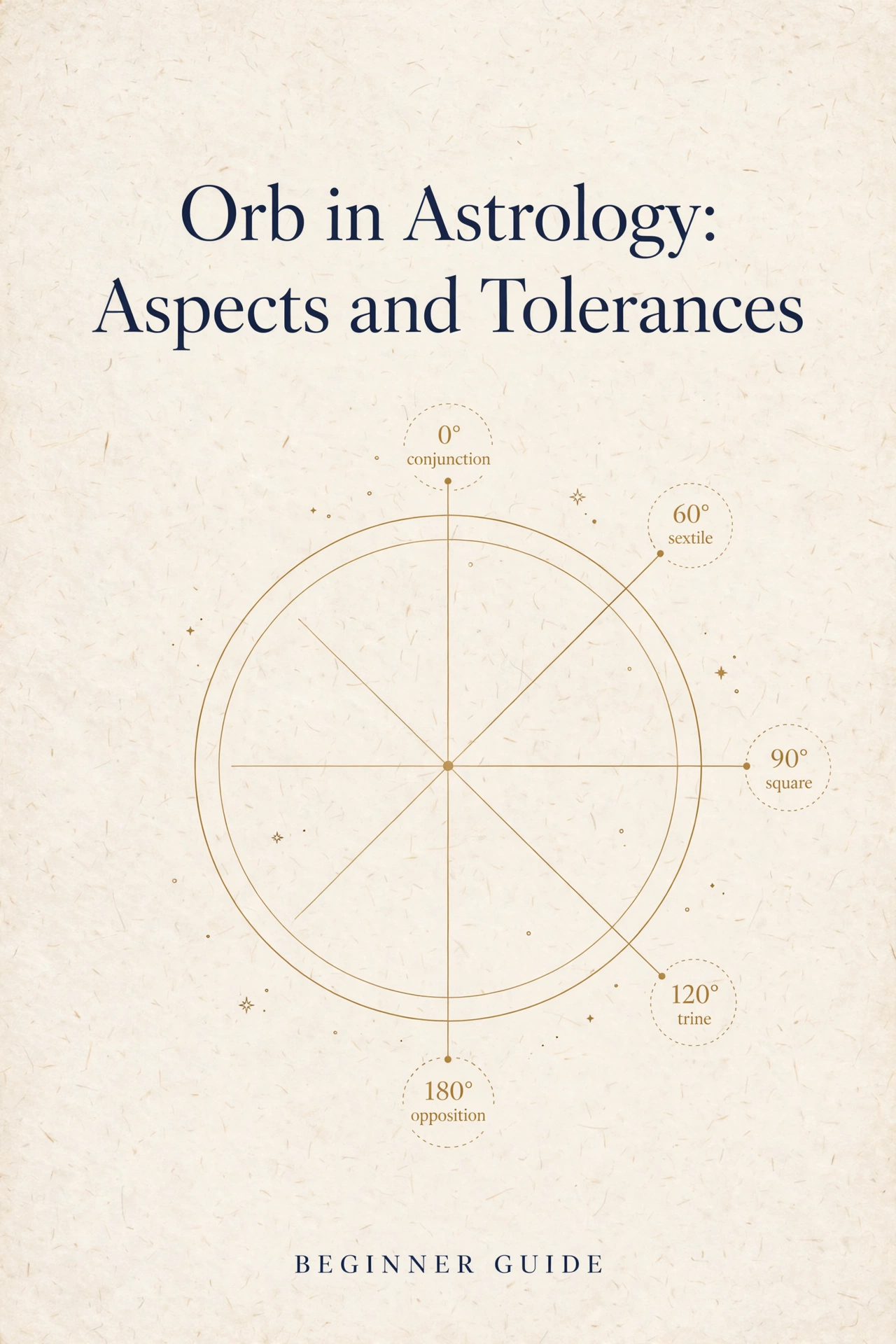
In astrology, an orb is the degree range that allows a deviation from the ideal angle between two planets; that is, it is still effective if the angle is not exact but remains within a certain tolerance. For beginners, the orb is a practical tool for identifying which angles establish the “same relationship” when reading the chart.
What is an Orb? (orb in astrology)
An orb is the amount of tolerance given around the exact value of an angle. For example, if a 6° orb is accepted for a trine (120°), then separations between 114° and 126° are considered trine. The orb works in both directions: the angle has a certain field of influence both as it approaches (applying) and as it separates (separating). As the orb gets larger, the angle is considered more loosely defined; as the orb gets smaller, the angle is regarded as more precise and stronger.
Types of Angles and the Relationship to Orbs
In astrology, angles are generally classified as “major” and “minor”; the application of orbs varies accordingly. Major angles (conjunction, opposition, trine, square, sextile) are more concrete and distinct; therefore, larger orbs are usually given. Minor angles are more subtle and nuanced, so smaller orbs are used.
- Conjunction (0°): Union, power density. Usually, the widest orbs are given.
- Opposition (180°): Polarity, tension, and awareness. A wide orb can be applied.
- Trine (120°): Flow, abilities; usually within a wide but meaningful range.
- Square (90°): Tension, requires transformation; its effect is pronounced and takes a medium width orb.
- Sextile (60°): Opportunity, external support; takes a narrower orb than trine.
- Quincunx / Inconjunct (150°): Relationship requiring adjustment; medium-narrow orb.
- Minor angles (e.g., semi-square, sesquiquadrate, quintile): Generally use very narrow orbs like 1–2°.
Narrow Orbs — The Logic of Strong Angles
As the orb decreases, the strength and precision of the angle increase. For example, an opposition with a 1° orb deviation (like 179° or 181°) feels much more direct and dominant, while an 8° deviation may be weaker and more generally influential. Thus, there are two main approaches discussed:
- Using wide orbs: You count more angles; you interpret the chart as “richer” but potentially more ambiguous.
- Using narrow orbs: You only take strong, sharp relationships; the chart is clearer, but some nuances may be overlooked.
A good rule: First identify the strongest relationships with a narrow orb; then, if necessary, consider broadening the orb according to context to think about additional nuances.
Also, many modern astrologers prefer very narrow orbs (e.g., below 1°) in systems that use harmonic angles or a lot of angles; otherwise, different angles may overlap each other and create contradictions.
Planetary Speed and Orbs
The speeds of planets affect orb selection. The general practice is as follows:
- Fast planets (Sun, Moon, Mercury, Venus, Mars): A smaller orb is applied. Because these planets move quickly in the chart and create short-term effects; a very wide orb can cause you to assign too much meaning to random small angles.
- Slow planets (Jupiter, Saturn, Uranus, Neptune, Pluto): A wider orb can be used. These celestial bodies are associated with long-term and collective themes; too narrow an orb may not encompass them adequately.
There is a similar application in transit interpretations: wider orbs are preferred for slow planet transits, while narrower orbs are chosen for fast planet transits. Additionally, “applying” angles are generally considered more effective; as an angle approaches, energy increases and becomes more apparent.
Practical Orb Values and Table
The following practical suggestions provide a safe starting point for those beginning to gain experience. You can base your approach on these and narrow it down over time according to your own style.
- Conjunction (0°): General: 8° — For Sun/Moon: 10°
- Opposition (180°): General: 8° — For Sun/Moon: 10°
- Trine (120°): General: 6° — For Sun/Moon: 8°
- Square (90°): General: 6° — For Sun/Moon: 8°
- Sextile (60°): General: 4° — For Sun/Moon: 6°
- Quincunx / Inconjunct (150°): General: 4°
- Minor angles (e.g., semi-square 45°, sesquiquadrate 135°, etc.): 1–2°
- Parallels / Declination (parallel, anti-parallel): 0°30’–1° (very narrow)
These values are not strict rules; there are differences between historical sources and modern practices. Some astrologers use wider general orbs, while others use much narrower ones. What matters is that you consistently apply the measurement system you choose and consider the context in interpretation (the meaning of planets, house placements, the nature of angles, and life events).
Summary / Key Points
- The orb is the allowed degree range in which angles have an effect; it helps determine which angle is “effective” when reading a chart in astrology.
- Major angles usually take wider orbs, while minor angles have very narrow orbs.
- Narrow orbs relate to stronger and more precise angles; wide orbs reveal more relationships but may create conflict in interpretation.
- Planet speed is important in orb selection: narrower orbs for fast planets, wider orbs for slow planets.
- Practical starting suggestion: Conjunction/Opposition ~8° (Sun/Moon +2°), Trine/Square ~6°, Sextile ~4°, Minor ~1–2°.
- Always check the context: the best guide in practice is a consistently tested approach based on experience and the narrative the chart tells.
Beginning series — other lessons:
Bir yanıt yazın
Yorum yapabilmek için oturum açmalısınız.