
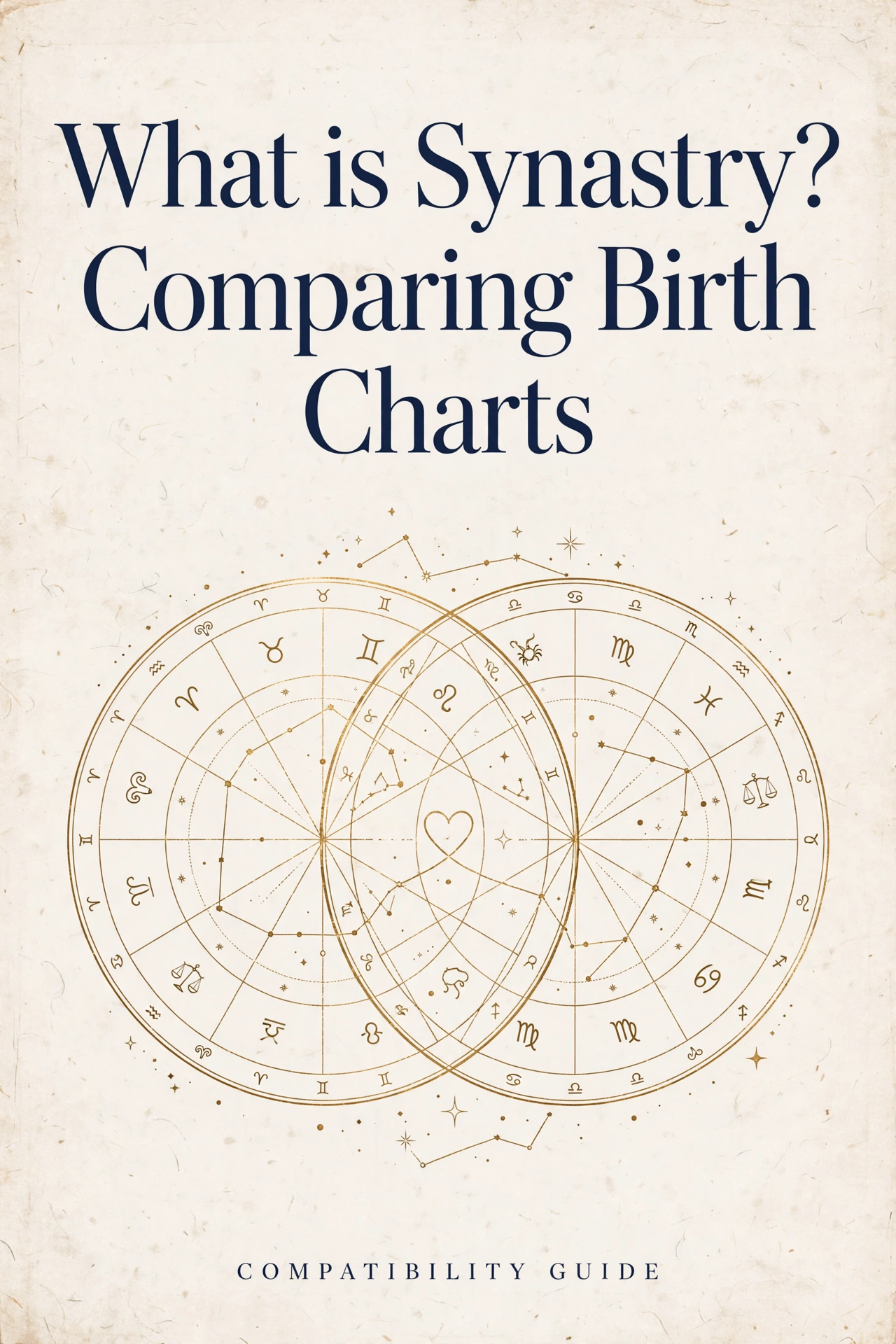
When you’re curious about the source of attraction or conflict between two individuals, astrology offers a deeper answer than a mere comparison of sun signs. Synastry (chart comparison) is a technique that reveals the dynamics in a relationship, how well needs can be met, and areas that require work by layering two birth charts. In this article, we explore what synastry is, how to read it, and how it differs from the “composite chart.”
What is Synastry?
Synastry, at its simplest, is the comparison of two birth charts: which signs and houses your planets fall into on their chart, and how their planets make aspects to yours. Looking only at sun sign compatibility is superficial — a healthy synastry reading requires a deep understanding of each natal chart independently, followed by an examination of how these two charts interact.
An important nuance: synastry does not determine “destiny.” Instead of giving a definitive judgment on how “compatible” two people are, it reveals the sources of attraction, how well mutual needs can be met, and the points in the relationship that will require effort.
How to Read Synastry?
Planets in Each Other’s Houses
Wherever one person’s planet falls in the other’s chart indicates that planet’s theme manifests in the subjects of that house. For example, if your Venus falls in your partner’s 11th house, there may be a strong theme of friendship/romance between you; Jupiter falling in the 12th house can create a deeper, almost spiritual bond.
Elemental Comparison of Sun, Moon, and Ascendant
According to astrologer Stephen Arroyo’s suggested approach, comparing the elements (fire, earth, air, water) of two people’s Sun-Moon-Ascendant signs reveals how well they align at an energetic level. They do not have to be the same element; complementary elements (e.g. fire-air) can also create a strong attraction.
7th House and Venus
A person’s general approach to relationships is already read in their natal chart, particularly through the 7th house and Venus. Synastry investigates how these individual indicators interact with the partner’s chart — in other words, synastry doesn’t replace the natal chart, it complements it.
Orb Consistency
The orbs used for aspects between the two charts are typically narrower than in natal interpretations (~5°, up to 6° for luminaries). The tighter the orb, the stronger the contact; the important part is to apply your chosen orb rule consistently.
Composite Chart: How is it Different from Synastry?
While synastry shows how two individuals interact with each other, a composite chart treats the relationship itself as a third, independent “entity.” A single horoscope is created by taking the midpoints of each planetary pair in the two charts; this chart shows the overall character of the relationship and how the couple behaves together. Synastry answers the question “how do we relate to each other,” while the composite looks at “what does this relationship generally look like.”
What to Keep in Mind When Interpreting Synastry?
- Don’t rely on scoring tables: Mechanical scoring methods like element counts or “how many aspects are positive/negative” can misleadingly oversimplify compatibility; a holistic reading is more reliable.
- Understand the natal chart first: Comparing with your partner’s chart without knowing your own needs will yield incomplete results.
- Synastry is not a “yes/no” answer: Challenging aspects do not mean the relationship will end, nor do easy aspects guarantee everything will run smoothly — what’s crucial is how these themes are worked on.
Synastry is one of the richest ways to read the story of two people in the sky chart; but like every astrological technique, it gains meaning only when understood alongside the foundational birth charts of both parties. If you want to clarify your 7th house and Venus placements in your own chart, you can first check our houses guide.
Bir yanıt yazın
Yorum yapabilmek için oturum açmalısınız.