
Introduction: Why are elements and qualities important?
\nAstrology offers a language woven around the 12 signs, four elements, and three qualities. Elements (fire, earth, air, water) provide symbolic clues about how a person perceives the world and what energy they nurture, while qualities (cardinal, fixed, mutable) show how that energy flows, whether it moves, or adapts. Together, these two layers play a fundamental role in interpreting the character and behavioral tendencies of planets in the birth chart.
\nThe Essence of Elements: Four Fundamental Energies
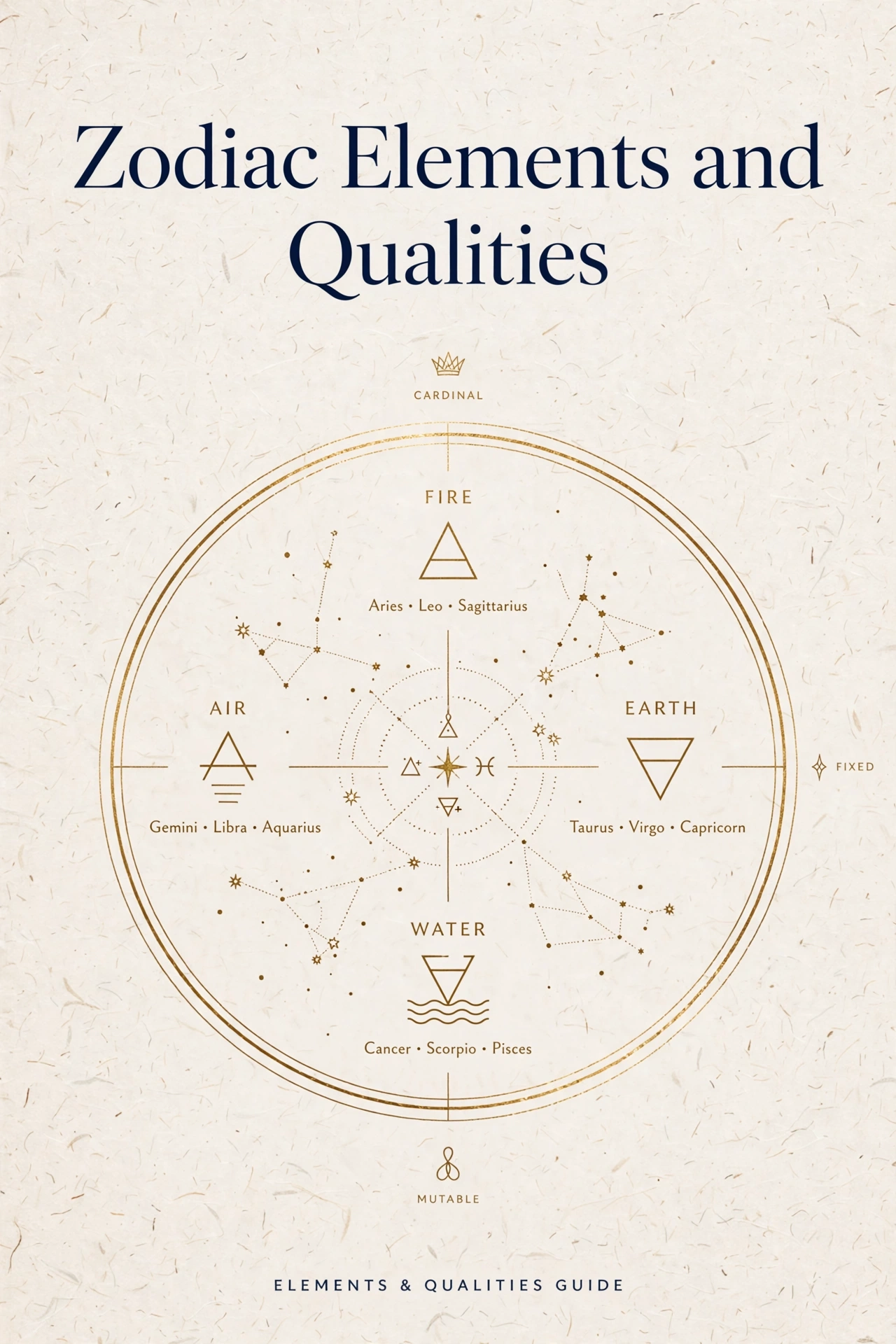
\nAs astrological symbols, elements represent different forms of psychological attitudes and approaches to life. Each one is shared by three signs, presenting different tones of the element.
\n- \n
- Fire (Aries, Leo, Sagittarius) — Experiences life as action: enthusiasm, creativity, entrepreneurship. Quick, inspiring but sometimes impatient and prone to distraction. \n
- Earth (Taurus, Virgo, Capricorn) — Grounded in the physical and material world: practicality, reliability, patience. Expertise in realization and sustainability. \n
- Air (Gemini, Libra, Aquarius) — Domain of mind, communication, and ideas: thought, connection, abstraction. Handles planning and sharing. \n
- Water (Cancer, Scorpio, Pisces) — Realm of emotion, empathy, and intuition: inner sensitivity, transformation, and attachment. Centers around feelings. \n
The dominant element in a birth chart strengthens a person’s core motivation. Prominent placements like the Sun, Moon, and Ascendant indicate which element is most influential.
\nQualities: The Flow of Energy—Cardinal, Fixed, Mutable
\nQualities create three different tones for each element and describe how energy moves within the chart. Each element has one cardinal, one fixed, and one mutable sign; thus the same element transforms into different behavioral styles.
\n- \n
- Cardinal (Aries, Cancer, Libra, Capricorn) — Initiator, entrepreneurial, change-oriented. This quality, governing the beginning of seasons, enjoys shaping the environment and control. \n
- Fixed (Taurus, Leo, Scorpio, Aquarius) — Resilient, protective, attached to the status quo. Represents the peak of the seasons and insists on maintaining things and preserving the system. \n
- Mutable (Gemini, Virgo, Sagittarius, Pisces) — Flexible, adaptable, governing transitions. This quality symbolizes the end of the seasons and carries the ability for transformation and adaptation. \n
The influence of these qualities on planets is significant; particularly the Sun is strongly affected by them: the Sun in a cardinal sign expresses the element most actively; in a fixed sign, it expresses more rigidly; while in a mutable sign, it expresses more harmoniously and flexibly. However, all planets and intensities in the chart should be considered together; if multiple planets dominate the same quality, the Sun’s qualitative influence may be overshadowed.
\nElement × Quality: Examples of Harmony and Conflict
\nWhen elements and qualities come together, rich and sometimes contradictory personality tones emerge. The following short pairings give an overall mood of these combinations:
\n- \n
- Cardinal + Fire (e.g. Aries): Activating, pioneering creativity. High power of initiation and inspiration. \n
- Fixed + Earth (e.g. Taurus): Resilient, organized, and productive. Pursues continuity and material security. \n
- Mutable + Air (e.g. Gemini): Flexible, adaptable, focused on knowledge and communication; quickly adjusts to changing conditions. \n
- Cardinal + Water (e.g. Cancer): Emotional initiative; tends to protect and guide their surroundings. \n
Elements also interact with one another. For instance:
\n- \n
- Fire–Earth: A strong but sometimes constricting combination where creativity transforms into tangible results. \n
- Fire–Water: A fusion of imagination and emotion; may be passionate but can flare up and extinguish quickly. \n
- Air–Earth: The practical application of thought; provides the ability to materialize ideas. \n
- Air–Water: A cloudy mingling of thought and emotion; creates a sensitive, poetic, and sometimes chaotic profile. \n
Tip: When reading combinations of elements and qualities, it’s not enough to look only at the Sun sign. The elemental density of planets in the chart shows which side of the personality is strengthened.\n
Practical: How to Start Reading?
\n- \n
- First, determine the element and quality of your Sun sign; this gives your core motivation. \n
- Then look at the elements of the Moon, Ascendant, and most influential planets; see which elements are lacking or dense. \n
- Remember the three quality forms of an element: Each element has a cardinal, fixed, and mutable sign — this reveals how energy flows. \n
- Pay attention to combinations: If multiple planets are in the same element, that element is strong; different elements create inner tension or complementarity. \n
Summary / Key Points
\n- \n
- Elements (fire, earth, air, water) symbolize how people perceive the world: action, physical reality, intellect, and emotion. \n
- Qualities (cardinal, fixed, mutable) show how the element flows — initiating, sustaining, adapting. \n
- Each element has three signs; this provides three different tones of the element and its place in the universal cycle. \n
- The Sun is particularly influenced by qualities; however, the chart should be read holistically. \n
- Combinations between elements enrich character; both harmonious and conflicting energies can emerge. \n
This fundamental framework serves as the first and most beneficial guide in interpreting the behavior of planets in your birth chart. By reading elements and qualities together, you will feel the rhythm of the chart more clearly and more accurately identify your personal tendencies, strengths, and areas of harmony.
\n\n
Beginner Series — Other Lessons:
\n- \n
- Fundamental Concepts of Astrology: A Systematic Guide to Understanding Your Birth Chart \n
- → Zodiac, Elements, and Qualities: The Fundamental Language of Astrology (this article) \n
- Sun and Moon: Core Functions of Identity, Emotions, and Motivation in Your Chart \n
- Meaning of Aspects and Orbs in Astrology: The Right Measure in Chart Interpretation \n
- Ascendant, MC, and Other Points in the Birth Chart: Identity, Career, and Relationships \n
- First Chart Reading: Step-by-Step Strategies for Interpreting the Birth Chart \n
Bir yanıt yazın
Yorum yapabilmek için oturum açmalısınız.