
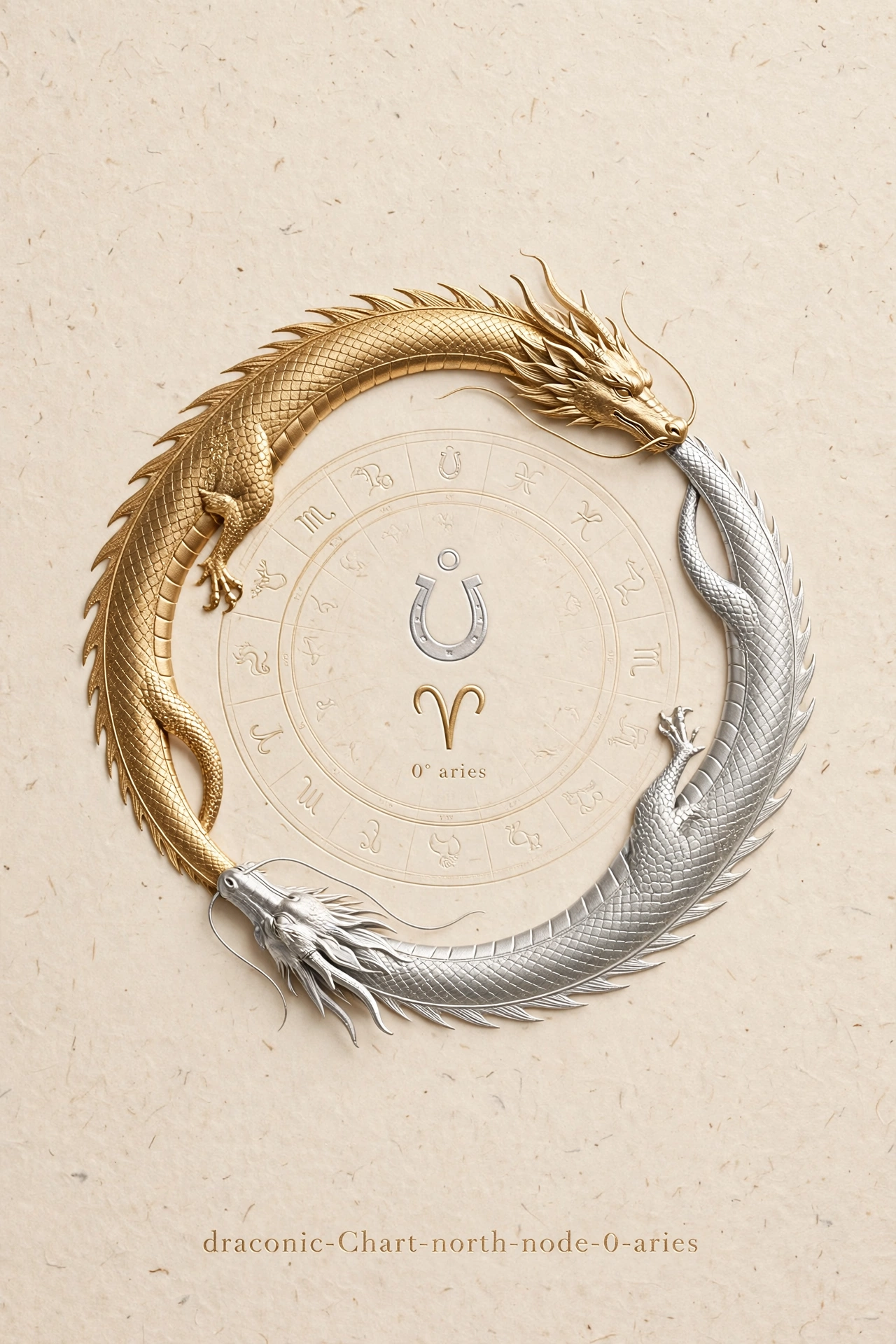
Your birth chart answers the question “who are you?” But what about the question “what do you intend to do?” One of the answers astrology gives to this second question is a peculiar and elegant technique named after a dragon: draconic chart.
One Simple Move: Setting North Node to 0° Aries
The calculation of the draconic chart is surprisingly simple. You take your birth chart and rotate the entire zodiac to set North Node to 0° Aries. The formula is one line:
draconic longitude = (natal longitude − North Node longitude) mod 360
So the measurement point changes. In the tropical chart, the zero point is the spring equinox (the moment the Sun crosses the equator); in the draconic chart, the zero point is where the Moon’s orbit intersects the ecliptic, that is, the North Node. The name “draconic” comes from here: in classical astronomy, the Moon’s nodes were referred to as caput draconis (the head of the dragon) and cauda draconis (the tail of the dragon).
The critical point is this: none of the angles made by the planets change. Since everyone shifts by the same amount, the Sun-Moon square remains square, and conjunctions remain conjunctions. The only thing that changes is the signs and — if you overlay the charts — where the draconic planets fall in your tropical chart.
How Much is the Shift?
Your North Node’s degree determines the shift. For someone with the node at 11° Taurus, the difference between draconic and tropical is only 41°; for someone with the node at 20° Libra, it’s 200°. This is why some charts may read draconic like a familiar layout, while others may read it entirely differently.
What Does It Indicate?
It’s important to mention that the draconic chart is a 20th-century technique that is not traditional. In the interpretation tradition, it is generally assigned the role: while the tropical chart describes personality and circumstances, the draconic chart illustrates the principles a person intends to live by — “if they are in contact with them,” with that qualification.
In practice, the most effective use is not to read it in isolation, but to overlay it with the tropical chart. The key question is: does a draconic planet fall on a sensitive point of the tropical chart (Sun, Moon, Ascendant, Midheaven, house cusp)?
- A conjunction of draconic Venus with the tropical Moon can be interpreted as the “way of loving” aligning with the “emotional nature” of that person.
- Draconic Moon resting on the cusp of the tropical 7th house indicates that relationships are at the center of the person’s intended life.
- Multiple overlaps, like the draconic horizon intersecting the tropical Sun-Mercury conjunction, are connected to a remarkably pronounced, “visible” life profile.
If there is no overlap — which happens often — the draconic chart usually remains silent. This is also a piece of information: the technique does not speak the same way in every chart.
Draconic and Synastry
The second area where draconic really shines is in relationship comparisons. While a strong connection may not be visible between the tropical charts of two people, the placement of one’s draconic planets on the tropical angles of the other indicates an interesting table: daily harmony may be weak but there is a deep alignment on the level of “intention.” The reverse can also be true — a seemingly perfect match in tropical may not connect at all on the draconic level.
Before making this reading, the classical synastry and composite chart should be established; draconic does not replace these, but rather adds to them.
A Honest Warning
The draconic chart is among the techniques in astrology that claim to operate on the “soul level,” a claim that is inherently untestable. It emerged as an attempt to explain observations that standard eastern or western charts could not clarify; this makes it intriguing but not provable.
Practical advice: use the draconic chart as a second reading, not as a primary decision-making tool. What your tropical chart says is fundamental; draconic is a light that falls upon it.
Draconic Chart on AstroMax
The Draconic calculation on the charts page generates your natal chart, rotating all planets based on the longitude of the North Node set to zero and recalculates the angles based on draconic positions. The result comes with the draconic sign and degree of each planet.
It does not show houses — and this is intentional: draconic transformation shifts the zodiac, not the horizon and meridian. If you want to read houses, you need to compare the draconic planets with the tropical houses of your chart; the technique is used this way already.
Where to Go Next?
- First, read the North Node article — the entire draconic chart is built upon that single point.
- Lunar nodes in signs and karmic astrology are other members of the same thought family.
- If you’re interested in techniques that alter the zero point of the zodiac, harmonic charts are a different application of the same logic: there, longitudes are not rotated but multiplied.
Bir yanıt yazın
Yorum yapabilmek için oturum açmalısınız.