
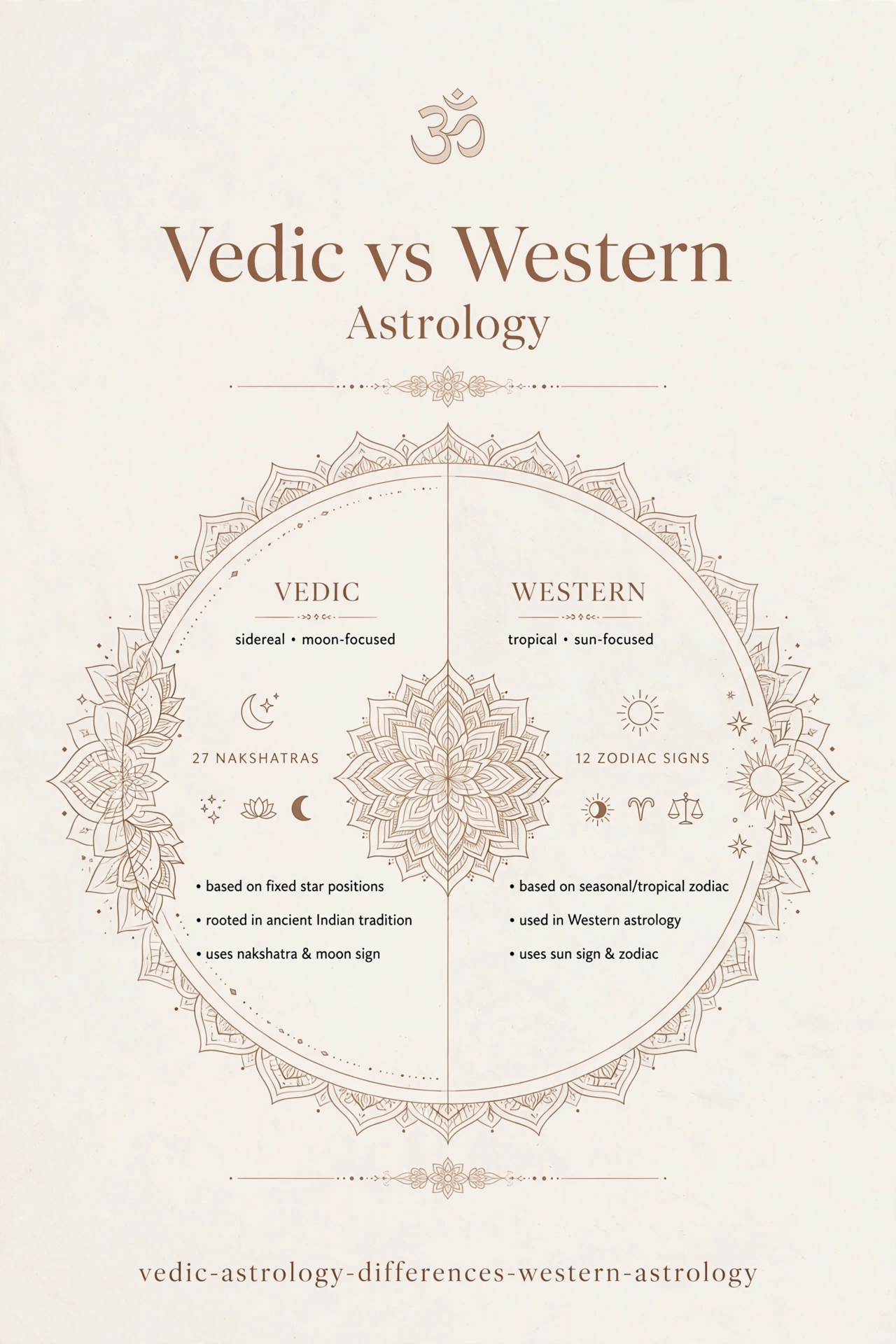
You may have heard the claim that “Your zodiac sign is actually different” — when calculated according to sidereal/Vedic astrology, many people’s Sun sign shifts back by one. This is not an error; it’s the result of Western and Vedic (Indian/Jyotish) astrology measuring the sky from completely different reference points. In this article, we explore what this difference is and why it exists.
Key Difference: Tropical or Sidereal?
Western astrology uses the tropical zodiac — the signs are fixed according to the seasonal position of the Sun; 0° Aries always corresponds to the spring equinox. Vedic astrology, on the other hand, uses the sidereal (star-based) zodiac — the signs are positioned according to fixed stars (constellations). Both systems use the same 12 signs and the same planets; the difference lies in where the “0 point” is fixed.
Why Do the Two Systems Diverge: Precession
The Earth’s axis wobbles slowly (like a spinning top) — this causes the equinox points to shift backward by about 50 arc seconds per year relative to the stars. Thousands of years ago, the tropical and sidereal zodiacs started from the same point; today, there is approximately a 24-degree difference accumulated between them. This difference is called ayanamsa — the correction value used by Vedic astrologers to move from the tropical position to the sidereal position in natal calculation (the commonly used Lahiri ayanamsa is around 24°).
Unique Tools of the Vedic System
In addition to the sidereal zodiac, Vedic astrology also carries its own technical language that does not have a direct equivalent in the Western tradition:
- Rahu and Ketu: The Vedic names for the North and South Lunar Nodes — they point to the same concepts as the “North/South Node” in Western astrology, but in the Vedic tradition, they are considered fully-fledged “shadow planets”.
- Dasa System: This is Vedic astrology’s unique timing technique — your life is divided into consecutive periods (dasa) governed by specific planets, along with sub-periods (bhukti). It is roughly equivalent to transit or progression techniques in Western astrology but is structurally completely different.
- Navamsa: A version of the natal chart divided into 9 parts (harmonics) — especially used to examine marriage and spiritual potential; conceptually similar to harmonic charts in Western astrology.
- Nirayana: Means “without deviation” and is the term used to refer to the corrected sidereal planet positions.
So Which One is “Correct”?
This is one of the oldest debates in astrology and does not have a single correct answer. Western astrology prefers the tropical zodiac because it aligns with the seasons and the Sun’s relationship with the Earth — it symbolically maps the “experienced reality”. Vedic astrology, however, prefers the sidereal zodiac because it remains true to the actual star positions in the sky. Both traditions have thousands of years of consistent practice behind them — one is not the “wrong” version of the other, but rather a different measurement philosophy.
Points to Consider
Someone who is a Leo in one system may come out as a Cancer in another — this can be surprising, but both systems are internally consistent; converting one to the other does not change your sign, it only changes the reference frame you are looking through. The in-depth, practical teaching of techniques like dasa and navamsa in Vedic astrology requires expertise in its own right — this article aims merely to introduce the basic conceptual difference, and is not sufficient to interpret a Vedic chart.
For Western astrology’s timing and calculation techniques (precession, critical degrees, progressions), you can look at our articles on Timing in Astrology and for the interpretation of Lunar Nodes in Western astrology, check out North Lunar Node.
Bir yanıt yazın
Yorum yapabilmek için oturum açmalısınız.