
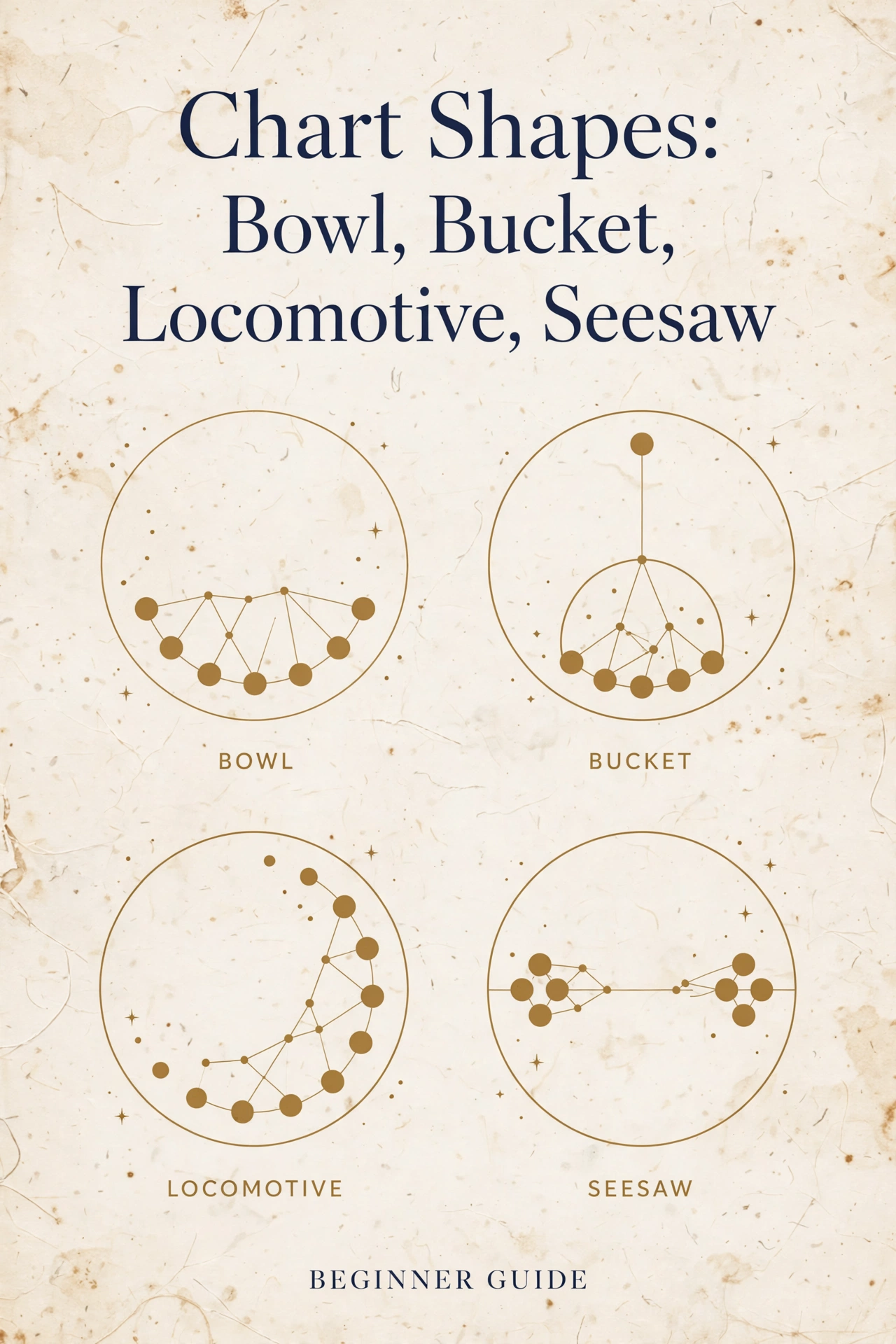
Have you ever looked at the overall “silhouette” formed by all the planets in your birth chart? Astrologers refer to this general appearance as the “chart shape” — and surprisingly, one of a few fundamental shapes fits almost every chart. In this article, we delve deeply into chart shapes such as Bowl, Bundle, Locomotive, Bucket, and Seesaw.
What is Chart Shape and Why is it Important?
Angular patterns (Grand Trine, T-Square, etc.) show how specific groups of planets relate to each other, while the chart shape provides a much broader picture: how the 10 planets are distributed within the chart’s 360° circle. This distribution reflects the individual’s general approach to the world and fundamental psychological tendencies — both filled areas and empty spaces carry meaning.
Bundle
All the planets cluster within one third of the chart. This indicates a limited but profound area of interest — the person responds with limited reactions to external stimuli but is strong in self-sufficiency with the resources they have. Typically, there is at least one stellium in this structure.
Locomotive
The planets cover two thirds of the chart, leaving one third empty. In this way, the “self” is driven more by environmental/external factors than by personal character traits — the person often has a forward-driving, goal-oriented energy; the empty space indicates potential that is pushed away but not utilized.
Splay/Tripod
The planets cluster around three separate centers, approximately 120° apart from each other. This “tripolar” pattern is associated with self-sufficiency and confidence — if there is a Grand Trine in the chart, the chart can automatically be considered to have this tripolar/confident nature.
Bowl
All the planets gather in half of the chart, with the two outermost planets forming an opposition (edge opposition). The individual has a strong inner resilience but feels somewhat disconnected from part of their experience, having a self-sufficient structure. The leading planet summarizes the person’s general approach to life. Bowl holders constantly face a dilemma: is it better to keep themselves restricted or to open up towards the empty half?
Bucket and Fan
When a single (or a few conjunct) “handle” planets are found at the opposite end of the Bowl pattern, a Bucket is formed. This handle planet brings a strong direction/inspiration to the rest of the chart — the individual becomes either a source of inspiration or a provocative force in the area represented by this single planet. The Fan is a more “clamped down,” concentrated version of the Bucket.
Seesaw
The planets are divided into two separate groups, which form opposing angles — alternating empty and filled ~90° spaces exist between them. This person lives their life constantly weighing two different perspectives; they have a strong ability to hold and balance opposing views, but sometimes this “two-sidedness” can be experienced as indecisiveness.
How to Interpret Chart Shape?
First, determine which half/third sections the planets are clustered in. Then, look for other angular patterns (T-Square, Grand Trine, etc.) within this general shape — for example, a Bowl pattern often contains a T-Square. When chart shape and angular patterns are read together, a much more detailed picture of the character and life circumstances emerges.
To examine the distribution of planets in your chart along with the houses, you can check our houses guide.
Bir yanıt yazın
Yorum yapabilmek için oturum açmalısınız.