
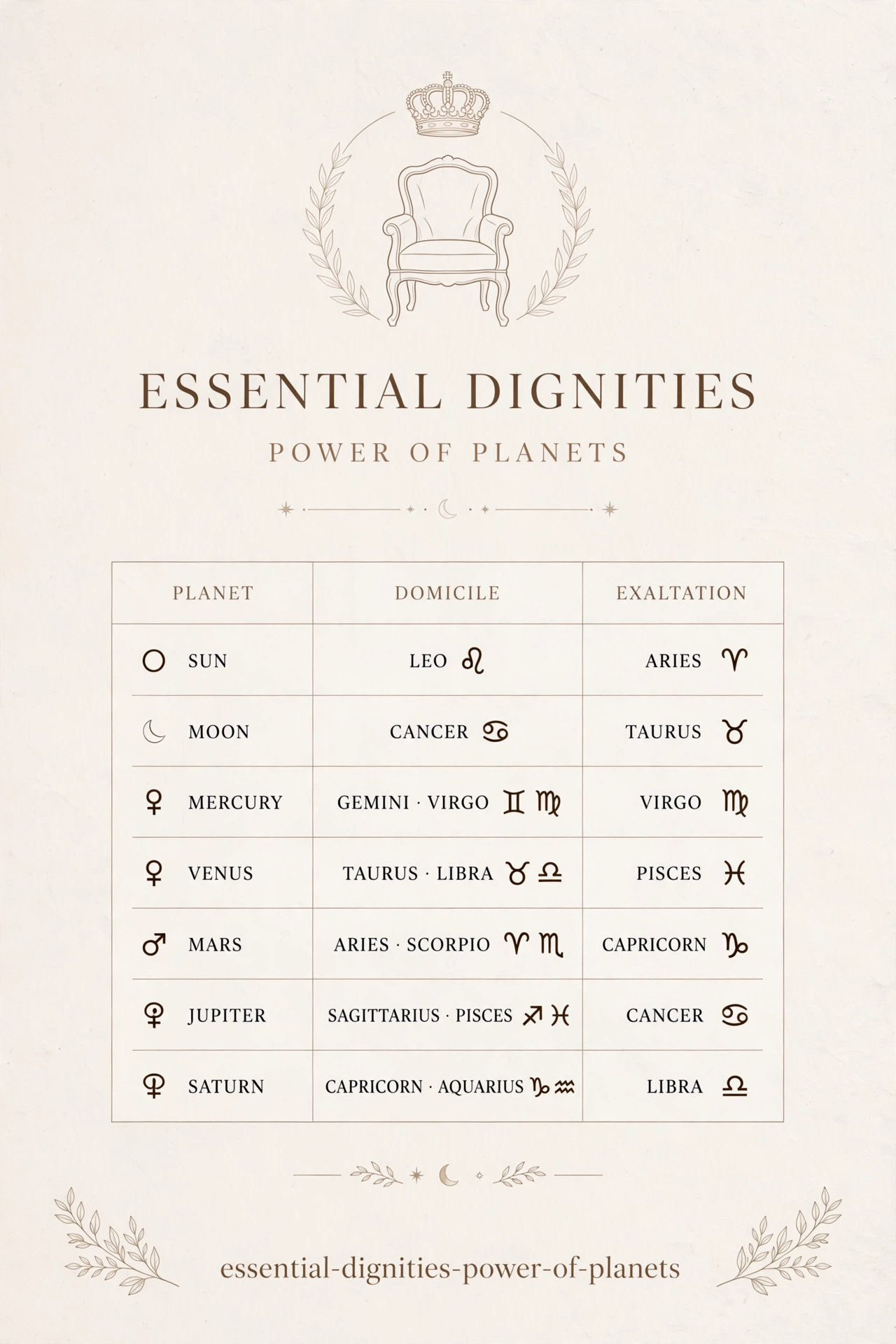
Even if two planets make the same aspect in a birth chart, their effects can be very different — because the strength or comfort of the planets in the signs they occupy varies. The classical system that measures this strength is called Essential Dignities. In this article, we discuss 5 dignities and 2 debilities along with a complete planet table.
Why is the Dignity System Important?
The position of a planet within a sign determines how comfortably/effectively it expresses itself. In classical astrology, this is measured by a 5-tier hierarchy of “strength” — 2 major (rulership and exaltation), and 3 minor (triplicity, term/bound, face). On the opposite end, there are 2 debilities (detriment and fall). When interpreting a chart, knowing whether a planet is “dignified” or “debilitated” in that sign greatly enhances the accuracy of the interpretation, not just considering the sign and house.
1. Rulership — The Most Powerful Dignity
When a planet is in the sign it rules (e.g., Mars in Aries, Venus in Taurus), it is at home — being in its own house makes it the most comfortable, natural, and powerful. This is the strongest of all dignities.
2. Exaltation — Second Major Dignity
Every planet has a sign where it is not a ruler but is still treated as a special “guest of honor.” In exaltation, a planet is strong in a way different from rulership — more “idealized,” more prominent power. Complete table:
- Sun: Exalted in Aries.
- Moon: Exalted in Taurus.
- Mercury: Exalted in Virgo (also being a ruler here, it is doubly strong).
- Venus: Exalted in Pisces.
- Mars: Exalted in Capricorn.
- Jupiter: Exalted in Cancer.
- Saturn: Exalted in Libra.
3-5. Minor Dignities: Triplicity, Term, and Face
- Triplicity: Each element (fire, earth, air, water) group has separate “triplicity rulers” for day and night — a planet in a sign of its own element carries this minor dignity.
- Term / Bound: Each sign is divided into 5 uneven segments, each with its own term ruler — a planet in its own term carries this minor dignity.
- Face: Each sign is divided into 3 decans of 10°, each with its own face ruler.
Key Rule: Two minor dignities are considered equivalent to one major dignity — meaning a planet with triplicity and term is roughly as strong as a planet in exaltation.
Debilities: Detriment and Fall
Every dignity has an opposite — a planet is in detriment if it is in the sign opposite the one it rules (e.g., Mars in Libra); it is in fall if it is in the sign opposite its exaltation (e.g., Sun in Libra, Moon in Scorpio). Complete fall table:
- Sun: Falls in Libra.
- Moon: Falls in Scorpio.
- Mercury: Falls in Pisces.
- Venus: Falls in Virgo.
- Mars: Falls in Cancer.
- Jupiter: Falls in Capricorn.
- Saturn: Falls in Aries.
A planet in detriment or fall is not “bad” — it merely struggles to express itself comfortably in that sign, requiring more conscious effort and maturity. Typically, planets in these positions indicate the areas of life where the person will experience the most growth over time.
Peregrine: Planet with No Dignity
A planet that has no dignity (major or minor) in the sign it occupies is called “peregrine” (wanderer/foreigner). A peregrine planet is considered neither dignified nor debilitated — it is neutral, in a state of being in “foreign lands”; in classical astrology, this position is often interpreted as the planet behaving somewhat directionless or opportunistically.
Sect (Day/Night) Factor
Dignities alone are not enough — sect (whether the planet belongs to the day or night chart you were born under) also influences strength. If the Sun is above the horizon when you were born (day chart), “day planets” like the Sun and Jupiter are more comfortable; if the Sun is below the horizon (night chart), “night planets” like the Moon and Venus are deemed more comfortable. A planet in a chart that aligns with its sect gains extra comfort along with its dignity.
Modern Planets and Dignities
Uranus, Neptune, and Pluto have no classical essential dignities because they were unknown when the classical dignity system was developed (before telescopes). While modern astrologers sometimes assign symbolic rulerships to these planets (Uranus-Aquarius, Neptune-Pisces, Pluto-Scorpio), this is not a classical form of “dignity” but rather a modern attribution — it is inconsistent from source to source.
How to Use Dignities in Practice?
When reading a chart, you might consider that a strong planet (ruler/exalted) will naturally and fluidly express that theme in your life, whereas a weak planet (detriment/fall) will only express the same theme through conscious effort, experience, and maturation over time. Dignities, combined with transit and critical degree analyses, clarify the strongest and most sensitive points in the chart.
Bir yanıt yazın
Yorum yapabilmek için oturum açmalısınız.