
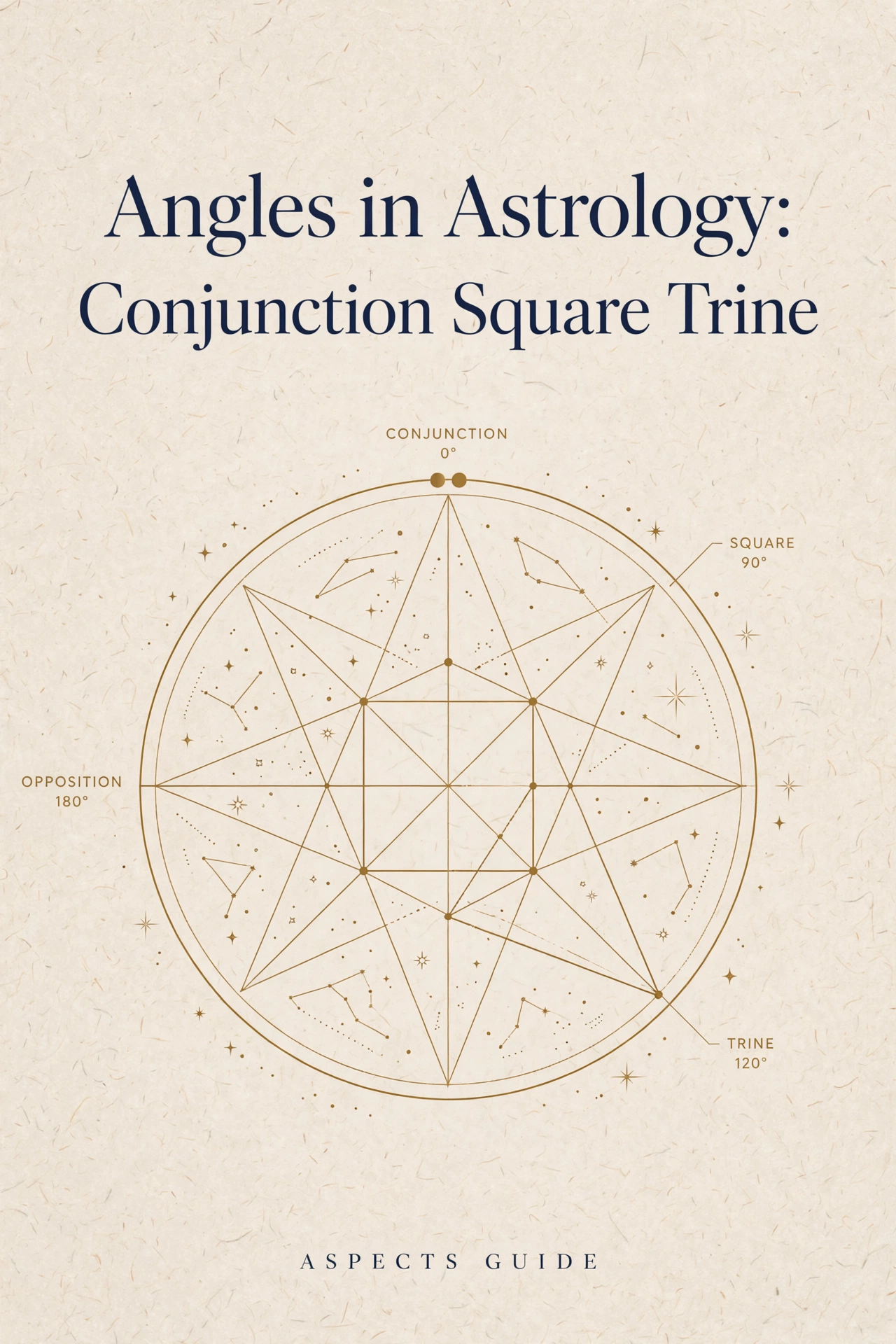
Planets in your chart show “what” is present, signs express “how”, and houses indicate “where” — but how do the planets communicate with each other? The answer lies in angles. In this article, we delve into the 5 fundamental angles of astrology (conjunction, opposition, square, trine, sextile) and the concept of orb.
What is an Angle?
An angle is the angular distance on the zodiac circle between two planets (or a planet and a point). There are 5 major angles used since Ptolemy’s ancient astrology classic Tetrabiblos: conjunction (0°), sextile (60°), square (90°), trine (120°), and opposition (180°). Each angle describes how the energies of the involved planets interact — whether they merge, conflict, support, or reconcile.
Conjunction (0°) — Merging
In a conjunction, two planets are very close to the same degree; their energies work together as a single whole without separation. This is the strongest angle and is neither inherently “good” nor “bad” — its effect completely depends on the nature of the planets involved in the conjunction. Typically, one planet (the stronger one by sign) becomes dominant and determines the direction of the conjunction.
Opposition (180°) — Polarization
Opposition occurs when two planets are directly opposite each other in the zodiac. This angle creates tension, polarization, and a sense of “either-or” — usually one pole is dominant while the other stays in the background, but over time roles may switch. Oppositions often manifest in relationships with others: the tendency to identify with one side and reject the other brings the rejected part into your external world (as a person or event). The solution is to establish a conscious balance between the two poles.
Square (90°) — Conflict and Crisis
A square produces open tension and concrete conflict — it is considered more “sharp” than opposition because there is no shared common theme, it involves direct friction. However, this tension is also a driving force: square angles compel us to face crises, make clear decisions, and grow. Squares in cardinal signs yield dynamic/aggressive responses, squares in fixed signs lead to stubborn resistance, while squares in mutable signs foster an easier tendency to adapt.
Trine (120°) — Harmony and Talent
A trine occurs between signs of the same element (fire, earth, air, water) and provides easy, flowing harmony. The planets understand and support each other and express a natural talent/luck. However, there is a price for this ease: without tension, the motivation to take action may be low — trines can also promote “laziness” since everything feels easy already.
Sextile (60°) — Opportunity
A sextile is similar to a trine but is a more active angle: it occurs between complementary elements (fire-air or earth-water) and offers an “opportunity” — but you need to take action to seize this opportunity. In a trine, you can remain passive; in a sextile, utilizing the potential is in your hands; an unused sextile is like a tool that sits in the toolbox but is never used.
Orb: The “Tolerance” of an Angle
Even if two planets are not exactly 90° or 120°, they are still considered to be making that angle within a certain degree range (orb). The typical orb for major angles is around 6-8° (can be a bit wider if the Sun or Moon is included), and for sextile, it is ~4-6°. The narrower the orb, the more powerful the effect is felt. There is no complete consensus among astrologers about exact orb values — the general tendency is to prefer narrow orbs.
The Golden Rule in Interpreting Angles
Modern astrology reads angles no longer with strict “good/bad” labels but in context: a square can sometimes be your greatest growth opportunity, and a trine can sometimes reveal an overlooked talent. What truly matters is which planets make this angle in which signs and houses — the name of the angle is just the beginning of the story.
To learn how the angles come together in your chart to form special patterns (like Grand Trine, T-Square), you can check out our article on angle patterns.
Bir yanıt yazın
Yorum yapabilmek için oturum açmalısınız.