
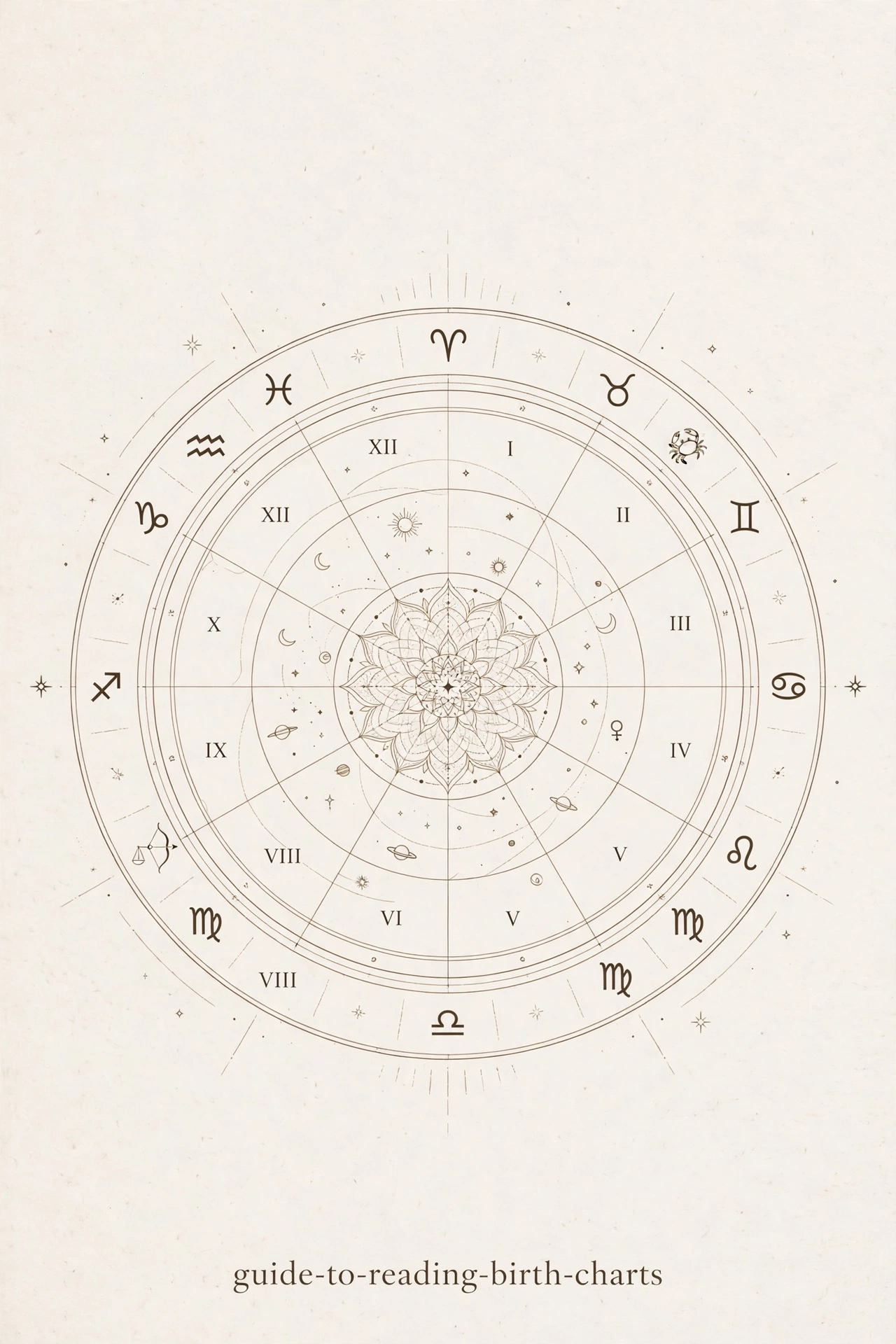
Your birth chart contains dozens of planets, signs, houses, and aspects — it’s possible to interpret the meaning of each individually, but the true art is to weave them into a single, coherent story. This article explains how astrologers synthesize a chart from start to finish, the order in which they look, and where to begin amid the “abundance of symbols.”
Why Do We Need a Method?
A birth chart contains many symbols speaking at once; to an inexperienced eye, this “abundance of symbols” can easily become overwhelming. A methodical approach allows for a step-by-step examination of the planets in sequential order, capturing the fundamental themes of the chart (recurring motifs) early on — keeping the interpretation from being scattered and leading to a coherent synthesis.
Step 1: The Big Three — Sun, Moon, Ascendant
The classical approach begins by identifying the Sun’s sign, element, and quality (cardinal/fixed/mutable); then the Moon, and finally the Ascendant, evaluated in the same manner. Looking at how these three relate to each other (Sun-Moon, Sun-Ascendant, Moon-Ascendant aspects and elements) gives early insight into the chart’s “core” tone — whether there’s harmony or tension between identity (Sun), emotional needs (Moon), and outward style (Ascendant).
Step 2: Process Each Planet Individually
Address each planet in turn: first recall the planet’s own psychological meaning (Mercury = mind, Venus = value/love, Mars = action, etc.), then combine this with the colors of the sign it sits in, and finally check which house it occupies and the aspects it makes. This three-layered approach (planet + sign + house, then aspects) is a consistent template for each planet.
Step 3: Balance of Element, Quality, and Distribution
Look at the distribution of the planets in the chart by element (fire/earth/air/water), quality (cardinal/fixed/mutable), and polarity (feminine/masculine) — a missing element or an overly concentrated quality can strongly shape the overall character of the chart. The accumulation of planets above/below the horizon, in the eastern/western halves, as well as large aspect patterns (e.g., kite, grand trine) are also structural clues that should draw attention at first glance.
Step 4: Catch Recurring Themes
The repeated emergence of the same theme across different layers (planet, house, aspect) — for example, both the Sun and Mars relating to the 10th house — reveals the chart’s true “main motif.” The power of interpretation comes not from exaggerating a single placement but from noticing points where multiple indicators point in the same direction.
Step 5: Deepen with House Rulers
For further refinement, find the ruler of the sign on the cusp of each house and check what house/sign that ruler is in (e.g., if the 7th house is Libra, Venus’s position completes the true story of the 7th house). This chain-like reading establishes unseen connections between houses.
Step 6: Synthesis — Bring It All Together
Place the short notes you’ve gathered for each planet side by side and go through the stages of analysis → integration → synthesis: first understand the pieces separately (analysis), then see how they interact with each other (integration), and finally combine them into a single, cohesive identity/life story (synthesis). A good interpretation is not a list of “Mercury says this, Venus says that” but a single story that these parts together tell.
Things to Keep in Mind
There is no definitive, universal ranking for which planets are considered “primary” (are only Sun-Moon-Ascendant-Saturn prioritized, or do all planets including Chiron count) — different astrologers use different priority orders; the steps provided here are a general framework, not a rigid rule. Additionally, when interpreting your own chart or that of someone you know, be careful that personal information you’ve previously gathered does not influence your interpretation — the essential skill is being able to hear only what the chart itself is saying.
For in-depth meaning of the Sun, Moon, and Ascendant, you can check our articles Sun in Signs, Moon in Signs, and Ascendant (1st House), and for general meanings of houses, look at our guide Houses in Astrology.
Bir yanıt yazın
Yorum yapabilmek için oturum açmalısınız.