
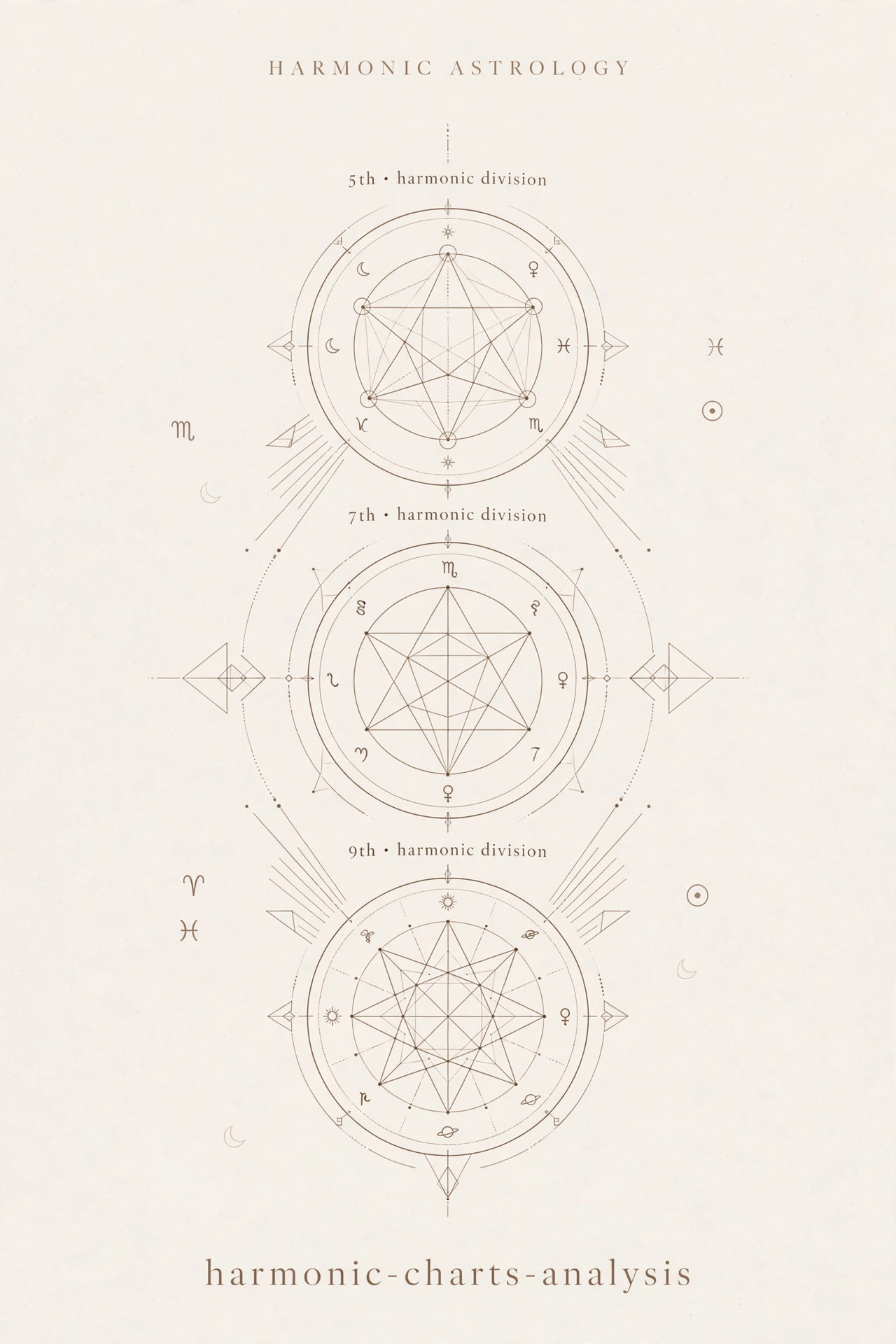
Did you know that you can mathematically “re-scale” your birth chart to obtain a completely different chart? This is the essence of the Harmonic Chart technique — a method systematized by English astrologer John Addey, which magnifies the hidden angle patterns in the natal chart. In this article, we discuss the mathematics of harmonic charts, the angle-harmonic table, and practical uses.
How to Calculate a Harmonic Chart?
The method is simple: the absolute longitude of each point in the chart (0-360°) is multiplied by an integer N; if the result is greater than 360°, 360° is subtracted until it remains less than 360°; the remainder is converted back to sign/degree format. When this process is repeated for all planets and points, the “Nth Harmonic Chart” emerges — this new chart highlights themes that resonate with the nature of the N number.
Harmonic-Angle Correspondence Table
Each harmonic number is associated with a specific type of angle obtained by dividing 360° by that number:
- 1st Harmonic (360°/1): Conjunction — the original chart, raw identity.
- 2nd Harmonic (360°/2=180°): Opposition — polarization, relational dynamics.
- 3rd Harmonic (360°/3=120°): Trine — flow, talent, ease.
- 4th Harmonic (360°/4=90°): Square — tension, action, structure building.
- 5th Harmonic (360°/5=72°): Quintile — creativity, unique talent.
- 6th Harmonic (360°/6=60°): Sextile — opportunity, ease of collaboration.
- 7th Harmonic (360°/7≈51.43°): Septile — intuition, a sense of destiny, mystical theme.
- 8th Harmonic (360°/8=45°): Semi-square — friction, restlessness.
- 9th Harmonic (360°/9=40°): Novile — completion, spiritual maturation.
- 10th Harmonic (360°/10=36°): Decile — power, success-oriented expression.
- 11th Harmonic (360°/11≈32.73°): Undecile — chaos, uncontrollability, inspiration.
- 12th Harmonic (360°/12=30°): Semi-sextile — growth, neighboring connections.
Multiples of a harmonic number continue to carry the same root theme — for example, the 10th harmonic, which is double the 5th harmonic (144°=bi-quintile), is still considered part of the “family of 5,” repeating the theme of creativity at a different intensity.
A Bridge from Vedic Astrology: Navamsa
The Navamsa, the most important auxiliary chart of Vedic astrology, is mathematically identical to the 9th Harmonic Chart — used for centuries as part of the Vedic system’s 16-layer “Shodasavarga” chart family. This establishes a direct mathematical bridge between Eastern and Western astrological traditions: two different cultures have arrived at the same 9th harmonic logic unknowingly.
Pioneers of Harmonic Charts
The technique was transformed into a systematic theory by English astrologer John Addey in the 20th century and later expanded with practical interpretation techniques by authors like David Hamblin. Addey’s fundamental proposition was that each harmonic number carries a unique, irreducible “quality” and that the chart can be read at these different “frequencies.”
Axis Rule: In Harmonics, “Opposite Ends” Are Not Automatic
An important technical detail to consider in harmonic calculations: in the normal chart, the Ascendant and Descendant (or the MC and IC, Vertex and Anti-Vertex) are always exactly 180° apart. However, this symmetry can be disrupted during a harmonic transformation — the multiplication can shift both ends to different degrees. Therefore, in serious harmonic analysis, the Descendant must be calculated separately from the Ascendant, the IC from the MC, and the Anti-Vertex from the Vertex; “predicting” one from the other by adding 180° can yield incorrect results.
Age Harmonics
One of the most popular practical applications of the harmonic technique is “Age Harmonics”: each year of a person’s life corresponds to a specific harmonic number/fraction, and the harmonic chart for that year can be calculated. If this Age Harmonic chart creates significant angles within a narrow orb (approximately 1°) with the natal chart, that age/period is expected to stand out prominently in life. This method is also used for rectification (narrowing down the birth time by matching it with past events) in charts where the birth time is uncertain.
When to Use a Harmonic Chart?
Harmonic analysis comes into play when you want to uncover a talent or theme that is strongly felt in life but not clearly visible in the standard natal chart (especially the themes of creativity, intuition, and spiritual maturation in the 5th, 7th, and 9th harmonics). When used in conjunction with midpoint analysis, it forms a powerful duo to capture subtle patterns overlooked by the standard angular system of the chart.
Bir yanıt yazın
Yorum yapabilmek için oturum açmalısınız.