
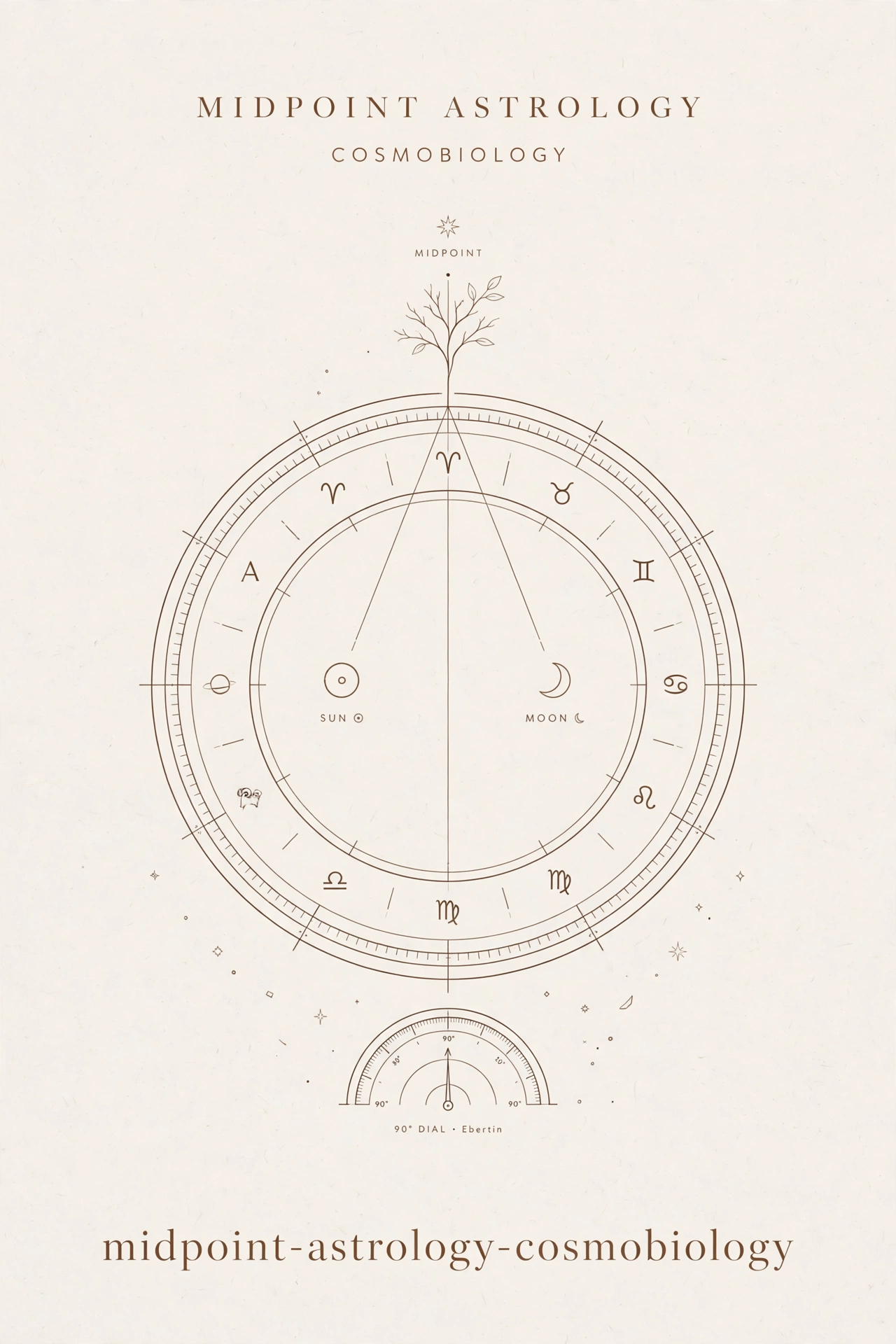
Even if there seems to be no angle between two planets, a hidden third point is active between them: midpoint. This technique, which is a cornerstone of the German “Cosmobiology” school, reveals the unseen subtle connections in the chart in relation to the standard aspect system. In this article, we discuss the logic, calculation, and most important combinations of midpoint astrology.
What is a Midpoint?
A midpoint is the exact central point between two chart elements (two planets, or an angular point such as a planet and the Ascendant/MC) — represented as “A/B” (e.g. Moon/Venus). This point is read as a third “synthesis” point where the energies of the two elements blend.
How is it Calculated?
To calculate, first, the positions of both elements are converted into a 0-360° absolute zodiac (in zodiacal order: Aries 0-30°, Taurus 30-60°, … Pisces 330-360°). The sum of the two values is divided by two. However, every midpoint actually has two versions: the “short arc” (the midpoint of the shorter distance between the two elements) and the “long arc” midpoint directly opposite this — these two are located opposite each other in the chart (180° apart) and both are theoretically active, but the short arc midpoint is usually considered primary.
Another mathematical property: if A+B = C+D, then the A/B midpoint is located at the same point as the C/D midpoint — meaning multiple planet pairs can “share” the same midpoint, making that point particularly dense/important in the chart.
The Most Important Midpoints
Theoretically, every pair combination in the chart forms a midpoint, but in practice, the most emphasized ones are those involving the Sun, Moon, Ascendant, and MC — because these four points are already the most personal/determinative elements of the chart. For example, the Sun/Moon midpoint (the person’s fundamental “integration” point) or the Ascendant/MC midpoint (the point where the person’s outward identity intersects with their purpose) is considered particularly powerful.
Example Midpoint Meanings
- Moon/Venus: Feminine energy, artistic sensitivity, themes of home and beauty — emphasis especially related to feminine expression/aesthetics.
- Mars/Saturn: Struggle, disciplined effort, hard-earned success — sometimes themes of repressed anger or challenges overcome with patience.
- Sun/Mars: Aggression, initiative, competitive energy — expression of masculine/active identity.
- Mercury/Jupiter: Intellectual expansion, optimistic mindset, capacity for teaching/spreading.
These combinations become active not only at the midpoint of two planets but also when a third planet conjoins that point (see below).
The Concept of “Hit”: When a Third Planet Comes Into Play
The strongest aspect of midpoint astrology is this: when a third planet (natal, transit, or directed) conjoins a midpoint, that third planet “activates” that midpoint, behaving as if it is directly conjoined with both original elements — the type of original relationship (whether it’s an aspect or not) does not matter. For example, when Mars conjoins the Sun/Moon midpoint, Mars’s energy is linked to both the Sun and the Moon as if it were in “conjunction”; this is typically read as a strong trigger in events timed with a transit or direction.
Cosmobiology and the 90° Circle
The German Cosmobiology school (led by Reinhold Ebertin) has systematized the midpoint technique, establishing a standard analysis framework for 132 midpoints formed by 10 classical/modern planets plus the Ascendant, MC, and Lunar Nodes. To manage such a large number of points, a special chart format called the “90° circle” is used — here, the 360° chart is compressed to 90°, so that “hard” aspects such as conjunctions, squares, and oppositions (all of which are multiples of 90°) appear stacked at the same point, making midpoint concentrations easily noticeable.
Practically Using the Midpoint
Midpoint analysis is particularly powerful for explaining subtle themes that are “invisible” yet still felt within the standard aspect system. The composite chart technique is essentially an application of this logic in relationship astrology — a “chart of the relationship” is created by calculating the midpoints of two persons’ planets. Combining midpoint precision with Solar Arc directions allows you to capture triggering moments throughout the year much more accurately.
Bir yanıt yazın
Yorum yapabilmek için oturum açmalısınız.