
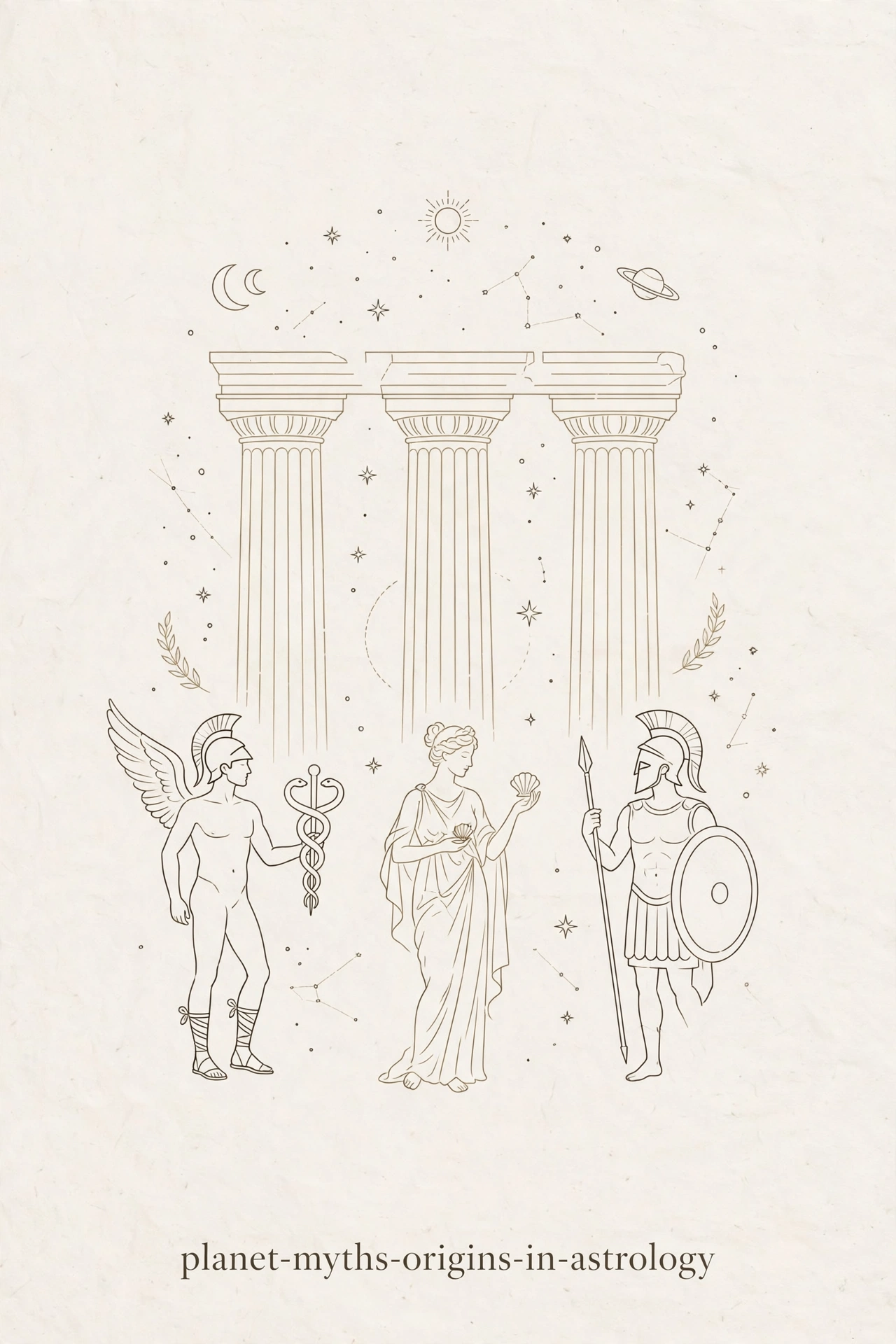
Why does Venus represent love, Mars represent war, and Saturn represent discipline? The answer lies not in the sky, but in the myths told thousands of years ago. Ancient astrologers did not ascribe meanings to the planets randomly; they reflected the personalities of the gods and goddesses of their time — and these gods were far from perfect.
Why Are Myths Still Important?
Ancient astrologers attributed unique, personal qualities to each planet and embodied them in the gods/goddesses of their era. These gods were not distant, unreachable figures — they interacted with humans and meddled in their affairs. They were not infallible as the myths describe: they were capricious, stubborn, and extremely “human.” They experienced love, faced betrayal, and sought revenge.
Mythology has a special power: as it is passed down through generations, personal/random details fall away over time, and only symbols that are truly valuable to a community survive. Therefore, looking at the myth of a planet is one of the most direct ways to understand that planet’s astrological essence — mythology is the distilled essence of the collective archetype.
Uranus: The First God of the Sky
Uranus is the first sky god in Greek mythology — born from Chaos, alongside his mother and wife, Gaia (Mother Earth), they are the first great couple that governs the realms of spirit and matter. Uranus is the personification of the sky itself: he gives life but also brings destruction through storms — this dual nature of both creation and destruction is the direct origin of the planet’s astrological “liberating yet tumultuous” character.
The myth also depicts Uranus as ruthless: he imprisons his own children in Tartarus because he finds them too “ugly and earthy.” Ultimately, he is castrated and deposed by his son Saturn (Cronus) and disappears from the Olympian pantheon — it is unclear whether he is dead or alive. He continues to exist only indirectly: the Furies (goddesses of justice/revenge) and the goddess of love Venus are born from his severed organ. The fall of one generation gives birth to the fundamental powers of the next generation (justice, love) — this is the mythical proof of Uranus’s principle that “destruction is also a new beginning.”
Jupiter/Zeus: The Only God Who Shares Power
Jupiter, known as Zeus in Greek, holds a unique position among his siblings: he acknowledges only himself as their father, shares power, and does not compete with them — this is the mythical foundation of Jupiter’s astrological nature of being “expansive yet not despotic, generously sharing.” Zeus’s later “births” bring various forms of feminine qualities to the world: the Graces (charm, joy), the Hours (the cyclical growth of time), and the Fates (powers that assign good and bad to individuals and impose responsibility for bearing one’s own fate). Jupiter’s expansion is not just about “more”; it is a productive principle that brings forth various dimensions of life into the world.
Pluto/Hades: The Indestructible Vital Force
Pluto represents nature’s power of survival and resistance to destruction — even if species perish, the life force itself continues, evolving into more harmonious new species. This is a form of immortality, but not spiritual: it is the pure, irreducible indestructibility of life. Pluto also represents the “dark heart” of nature — a force that resists all forms of civilizational efforts, making those who disrespect it pay a price (even in the name of progress). The transformative, sometimes destructive crises brought by Pluto in the birth chart are directly rooted in this mythical origin.
Venus/Aphrodite: Beauty and Jealousy Together
The goddess of love, Venus (Aphrodite), can be romantic and pleasure-seeking, but she can also be erotic, jealous, and even destructive. Myths tell that the Trojan War arose from a beauty contest — from Venus’s ambition to win the title of “most beautiful.” This duality (the unifying yet destructive power of love) is the origin of both harmony and jealousy themes in Venus’s birth chart.
The Continuity of Names
Today, planets are still referred to by the Latin names of Greek gods: Mercury=Hermes, Venus=Aphrodite, Mars=Ares, Jupiter=Zeus, Saturn=Cronus, Neptune=Poseidon, Pluto=Hades. Remarkably, astronomers maintained the same ancient tradition when naming three new planets discovered in the 18th-20th centuries (Uranus in 1781, Neptune in 1846, Pluto in 1930) — and these names are still meaningful mythologically. The attempt to name Uranus after its discoverer William Herschel was unsuccessful; the ancient name proved more powerful. There were also attempts in the Middle Ages to “Christianize the prophet’s rainbow,” but the ancient symbols of astrology were so vivid that they could not be replaced with other names.
Things to Consider
Use mythology not as “proof” in chart interpretation, but as a background to understand the psychological and societal functions of the planet — especially for outer planets (Uranus, Neptune, Pluto), myths make it easier to see the underlying collective/archetypal meanings of transits and birth chart effects. Remember the “imperfect, human-like” behaviors of ancient gods: the dark side of a planet’s myth (Uranus’s ruthlessness, Venus’s jealousy) is also valuable for understanding the shadow side of that planet in your chart — taking only the “good” side misses the entirety of the myth.
For the technical meanings of the planets in the birth chart, you can check our series on Sun in the Signs, and for the deep psychological dimension of outer planets, take a look at our article Neptune and the Search for Salvation.
Bir yanıt yazın
Yorum yapabilmek için oturum açmalısınız.