
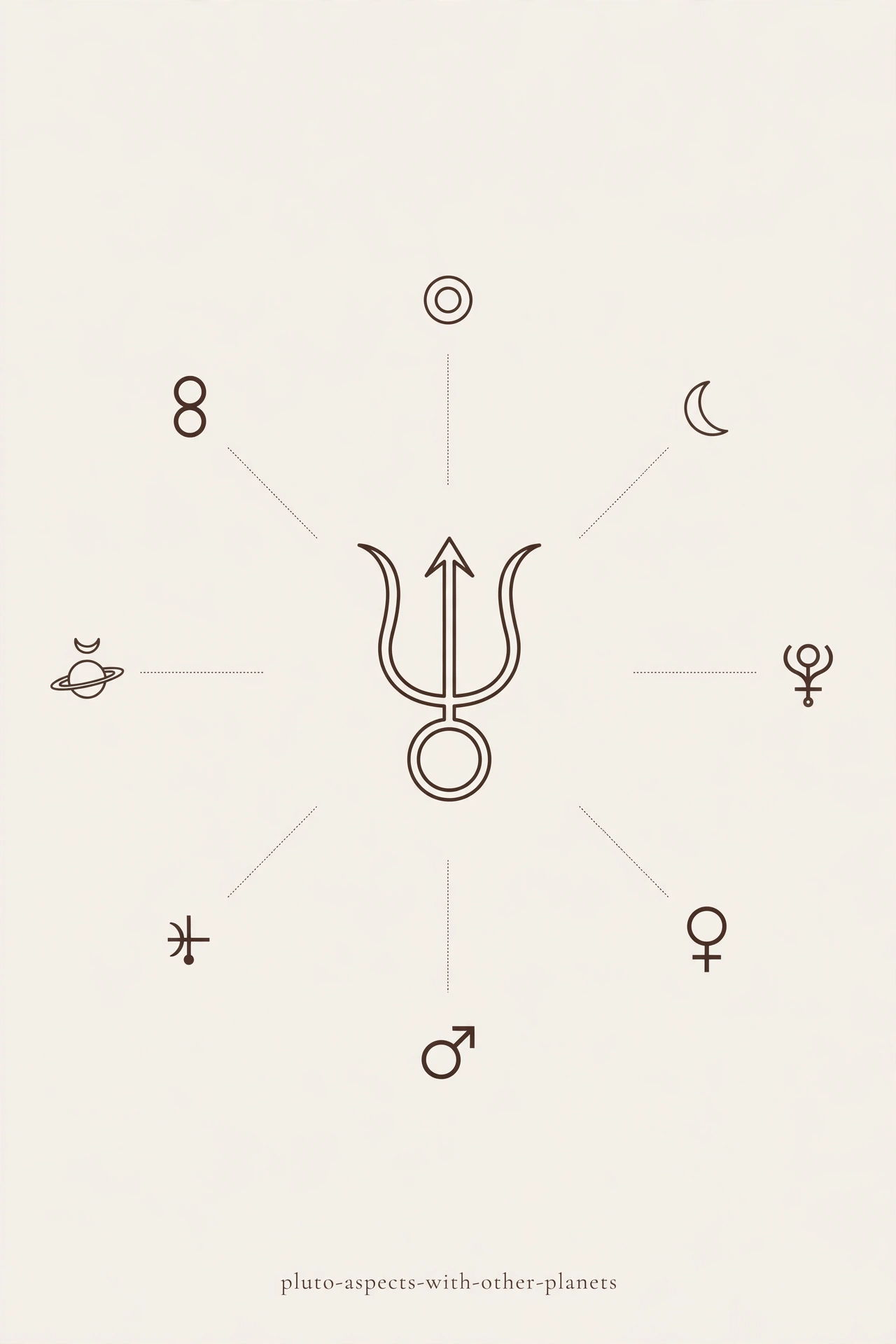
Pluto is the planet of power, transformation, and rebirth — the aspects it makes with other planets reveal what you are trying to control, which crises are transforming you, and where you derive your power. In this article, we discuss the aspect dynamics Pluto forms with the other 13 planets/points.
Pluto – Sun Aspects
Adds power and transformation to identity; for a detailed analysis, you can refer to the “Sun-Pluto” section in our Sun Aspects article.
Pluto – Moon Aspects
Adds intensity and control dynamics to emotional life; for a detailed analysis, you can refer to the “Moon-Pluto” section in our Moon Aspects article.
Pluto – Mercury Aspects
Directs the mind towards a deep and questioning focus; for a detailed analysis, you can refer to the “Mercury-Pluto” section in our Mercury Aspects article.
Pluto – Venus Aspects
Adds depth, intensity, and power dynamics to relationships; for a detailed analysis, you can refer to the “Venus-Pluto” section in our Venus Aspects article.
Pluto – Mars Aspects
Intensifies willpower and energy; for a detailed analysis, you can refer to the “Mars-Pluto” section in our Mars Aspects article.
Pluto – Jupiter Aspects
Amplifies the desire for large-scale transformation and power; for a detailed analysis, you can refer to the “Jupiter-Pluto” section in our Jupiter Aspects article.
Pluto – Saturn Aspects
Represents the conjunction of restriction and deep transformation; for a detailed analysis, you can refer to the “Saturn-Pluto” section in our Saturn Aspects article.
Pluto – Uranus Aspects
Essentially an indicator of generational/social transformation; for a detailed analysis, you can refer to the “Uranus-Pluto” section in our Uranus Aspects article.
Pluto – Neptune Aspects
Indicates collective/generational mystical transformation; for a detailed analysis, you can refer to the “Neptune-Pluto” section in our Neptune Aspects article.
Pluto – Chiron Aspects
A powerful vibration that combines shadow, trauma, and transformation/healing processes. Trine/sextile aspects provide a sense of early destiny, healing ability, and allow this energy to be channeled into professional/creative avenues (teaching, publishing, esoteric writing). Square/quincunx/opposition aspects create intense stress, persistent inner urges, and difficulties in feeling power — but this tension triggers continuous transformational work and service to others. The dynamics are karmic: early family/parent relationships can either obstruct or activate the operation of this aspect.
Pluto – North Node Aspects
Indicates that the individual must continue the transformational task inherited from past lives in this life — the North Node takes on the role of a “pole point” for Pluto here. Stressful aspects indicate reliving the past, while non-stressful aspects indicate maturation (“fruition”). The first traces of these themes are often seen in early childhood experiences.
Pluto – South Node Aspects
Holds a strong karmic signature — particularly conjunctions are associated with the revival of past life patterns or a transformative rebirth. The effects can be sudden, uncontrollable, and transformative; due to Pluto’s slow movement, the full results become clear over time. Orbs of up to 15° in conjunctions are considered significant — this is a noteworthy technical nuance, different from other pairs.
Pluto – Lilith Aspects
Represents the clash between Pluto’s transformation and power dynamics and Lilith’s unconscious, shadow impulses — it can either offer deep restructuring opportunities or lead to the Lilith energy remaining in the shadows, morphing into a vague inner anguish. Harmonious aspects (sextile, trine) provide transformative opportunities and insights, whereas challenging aspects (conjunction, square, opposition, quincunx) can trigger suppressed fears and crises. Direct information specific to this pair is limited in sources; interpretations are partially derived from Pluto-Moon themes.
Things to Note
Do not automatically label any aspect of Pluto as “destructive” — when it finds a suitable outlet (sports, competition, constructive struggle, therapy), this energy transforms into extraordinary transformative power. Even harmonious aspects (trine, sextile) are not always “easy” — while they may seem relaxed externally, underlying power dynamics and unconscious motivations often continue. Due to Pluto’s slow movement, the effects should be read as long and deep processes rather than sudden outcomes; avoid short-term “fate” judgments.
For general definitions of aspect types, you can refer to the Guide to Aspects in Astrology.
Bir yanıt yazın
Yorum yapabilmek için oturum açmalısınız.