
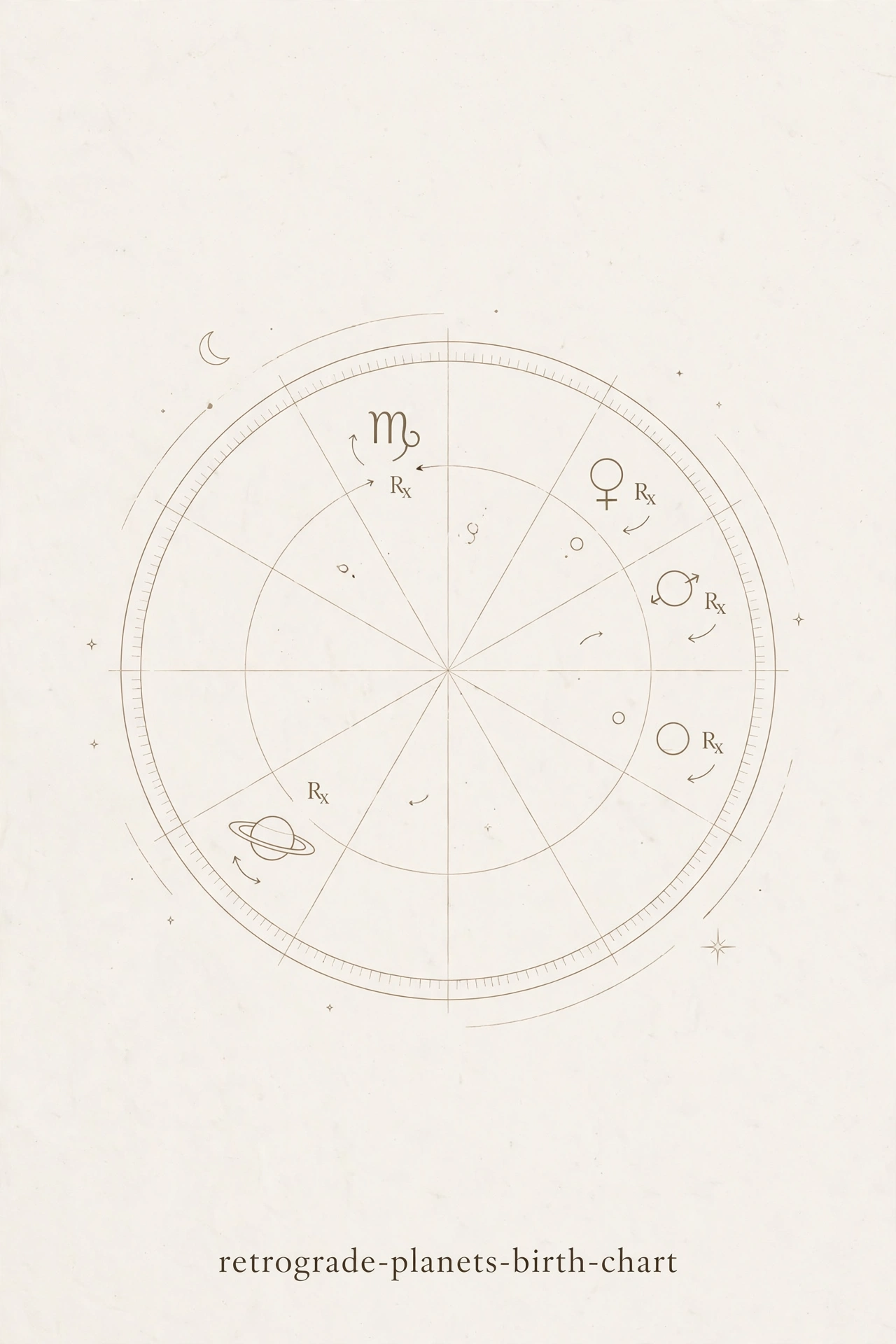
Retrograde is when a planet appears to move backward in the sky as seen from Earth (it is not a real change of direction, but an optical illusion). If you have a retrograde planet in your birth chart, that planet’s energy turns inward rather than outward — it takes on a more subjective, deeply processed, and somewhat “blocked” quality in expression.
What Does Retrograde Mean?
- Internalization: The planet’s function often retreats into the unconscious rather than coming directly to consciousness — it creates a theme that works inward, requiring repetition and review.
- Not a barrier, but a concentration: Expression may seem weakened or delayed, but this also means the experience becomes more subjective and intense, providing an opportunity for inner deepening.
- Position relative to the Sun: Most retrograde planets are sectorial to the Sun; this indicates that the planet plays a “questioning, introspective” role in identity formation, sometimes carrying a potential for rebellion or standing apart.
- Frequency difference matters: The retrograde cycles of some planets gain significance through their rarity — Mercury goes retrograde about every 4 months, while Venus does so approximately every 8 years; this frequency influences the weight of retrogradation in annual interpretation.
Typical Effects by Planets
- Retrograde Mercury (natal): Withdrawal in communication and confidence; tendency to review thoughts repeatedly instead of expressing them immediately — while it may appear “slow” from the outside, deep processing occurs inside.
- Retrograde Venus (natal): Timidity in relationships, preference for one-on-one connection over crowd; tendency to hold love and value internally for a long time before expressing.
- Retrograde Mars (natal): Difficulty in taking action or initiating something; anger and desire may build up inside instead of flowing outward and may express itself through indirect means over time.
- Retrograde outer planets (Uranus, Neptune, Pluto): These planets already move slowly, so their retrograde periods are long and generally signify a transformation of the collective/unconscious rather than personal consciousness — they can be effective across generations.
How to Read a Retrograde Planet in Your Chart?
- Note planets marked with “R”: Especially the natal retrogradation of Mercury, Venus, and Mars makes a significant difference in interpretation — these three are personal planets, so their influence is felt more directly.
- Look at the direction of the function: Is the planet’s function operating in consciousness or the unconscious, directed outward or inward, question this — sometimes this function remains outside of consciousness and requires conscious work (therapy, self-awareness practice).
- Follow in the Solar Return and progressions: When a progressed planet enters retrograde position, it indicates a period of review/re-evaluation in that area; when it moves back to direct position, a new direction and progress begin.
Points to Consider
Don’t fall into the misconception that retrogrades are automatically “bad” or “lacking” — alongside the weakening of energy or blocking of expression, opportunities for internalization, resilience, and deepening also arise. Outer planets (Uranus, Neptune, Pluto) are already retrograde for much of the year, so they may sometimes be unnecessarily ignored in natal interpretations; however, their retrogradation should be evaluated in context as they emphasize the collective/unconscious plane.
For periodic Mercury retrograde on a specific date, you can check our article What is Transit? For the general meaning of natal Mercury, you can refer to our article Mercury in Signs.
Bir yanıt yazın
Yorum yapabilmek için oturum açmalısınız.