
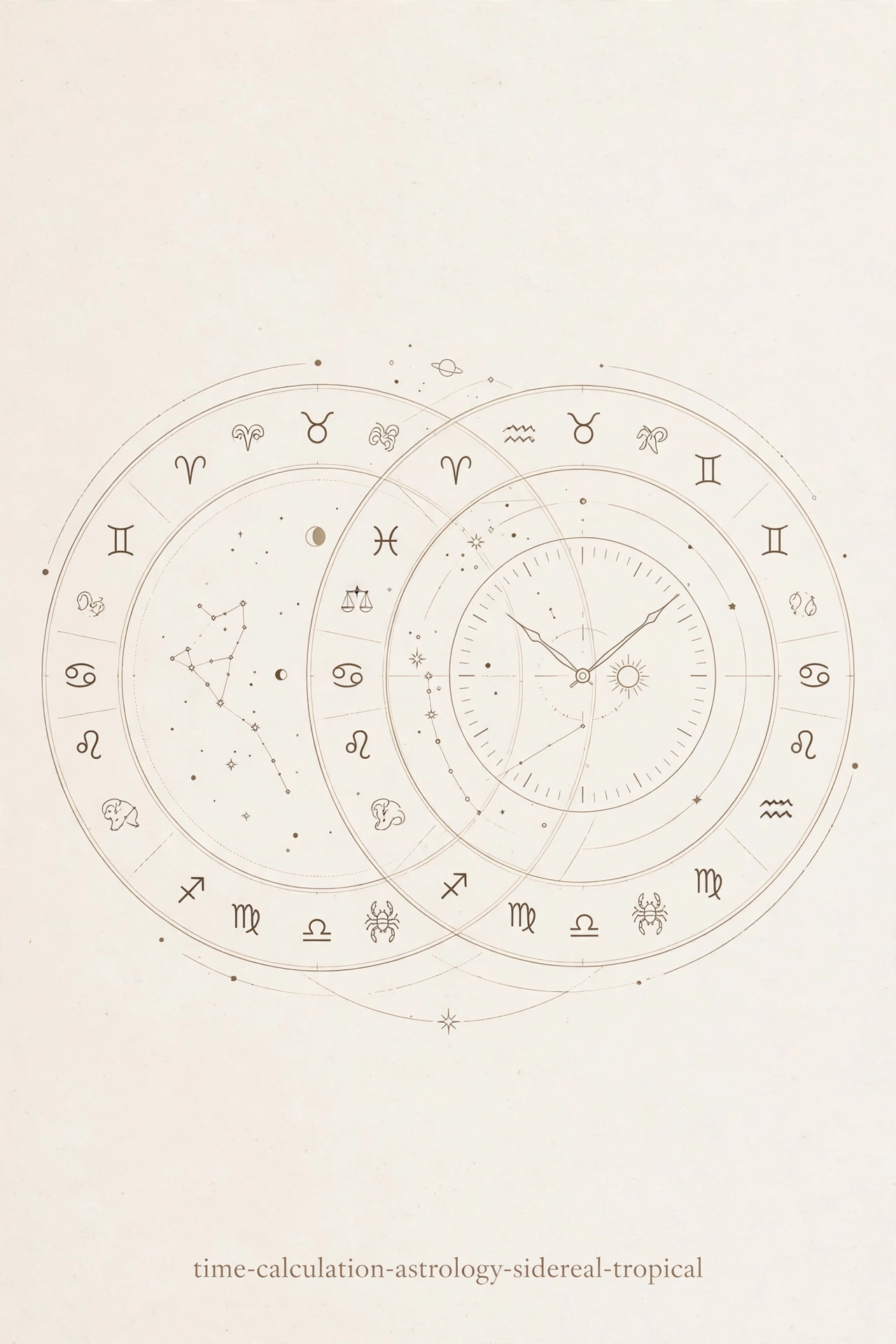
A birth chart is a frozen photograph of the sky at the moment you were born — but taking this photograph is a much more precise task than it seems. Why does your Ascendant change within minutes? What do astrologers mean when they say “1 degree = 1 year”? In this article, we explore how astrology measures the sky and translates time into charts.
Two Different Years: Tropical and Sidereal
Astrological calculations are based on two different but interconnected time systems. The system we use in daily life is based on the tropical year — it relies on the Sun’s position according to the seasons. Sidereal time, however, is based on Earth’s rotation in relation to the fixed stars; the sidereal year (365 days 6 hours 9 minutes 9.5 seconds) is slightly longer than the tropical year, and the sidereal day is slightly shorter than the normal solar day (23 hours 56 minutes 4 seconds). While Western astrology uses the tropical zodiac, Vedic (Indian) astrology is based on the sidereal zodiac — this difference explains why the zodiac dates diverge between the two traditions.
Precession of the Equinoxes
Earth’s axis gradually wobbles (like a gyroscope), causing the equinox points to shift approximately 50.25 arc seconds backward relative to the stars each year — this is called “precession”. This slow shift leads to an increase in the difference between the tropical and sidereal zodiacs over thousands of years and forms the mathematical basis for discussions of “astrological ages” (such as the transition from the Age of Pisces to the Age of Aquarius).
Why Are the Ascendant and MC So Precise?
The Ascendant and Midheaven (MC) move much more quickly relative to other points in the zodiac — about 1 degree every 4 minutes. This means that even a few minutes of error in your birth time could cause your Ascendant to shift into a neighboring sign, or even significantly change its degree within the same sign. Therefore, in charts where the birth time is uncertain, astrologers resort to the method of “rectification” (calculating birth time backwards by looking at significant life events). “Sensitive points” calculated based on the Ascendant, like the Part of Fortune, are also cautiously assessed for this reason — some astrologers argue that the midpoints of planet pairs (the average sums) are more reliable instead.
The “1 Degree = 1 Year” Principle: Primary Direction
One of the oldest timing techniques in ancient and medieval astrology uses the daily rotation of the sky (the “rising degree” measured along the celestial equator) as a symbolic measure of age: about every 4 minutes of real time corresponds to one year of life — thus, the sky movement up to 6 hours after birth symbolically represents a life span of about 90 years. Although various variations of this principle have been introduced by medieval and early modern astrologers since the time of Ptolemy, the average value has always remained around “approximately 1° = 1 year”. For example: a planet at the Ascendant at the moment of birth is considered to indicate a significant period corresponding to that age when it reaches due east (a few hours later).
Difference with Progressions
Unlike primary direction, secondary progressions use the formula “one day = one year”: each day after birth corresponds to one year of your life (for example, the planetary positions on the 30th day symbolize the themes of your 30th year). The philosophical foundation is this: birth is not a single moment but a continuous process — the chart is considered to continue to “mature”. Some astrologers argue that relying solely on the positions at the birth moment, ignoring real (secondary) movements after birth, provides more reliable practical results — this is one of the contentious points between techniques.
Things to Consider
Different symbolic direction and progression techniques (such as primary direction, secondary progression, solar arc) are applied to the same birth chart, but each provides different, complementary information — one does not replace the other. Sensitive points based on the Ascendant (sensitive points, some house systems) lose their reliability if the birth time is not known precisely; therefore, if you are unsure of the accuracy of your birth time, approach results that depend too rigorously on the Ascendant with caution.
For practical applications of these techniques in a birth chart, you can check our articles on Progressed Sun, Solar Arc Directions, and Holistic Chart Reading Guide.
Bir yanıt yazın
Yorum yapabilmek için oturum açmalısınız.