
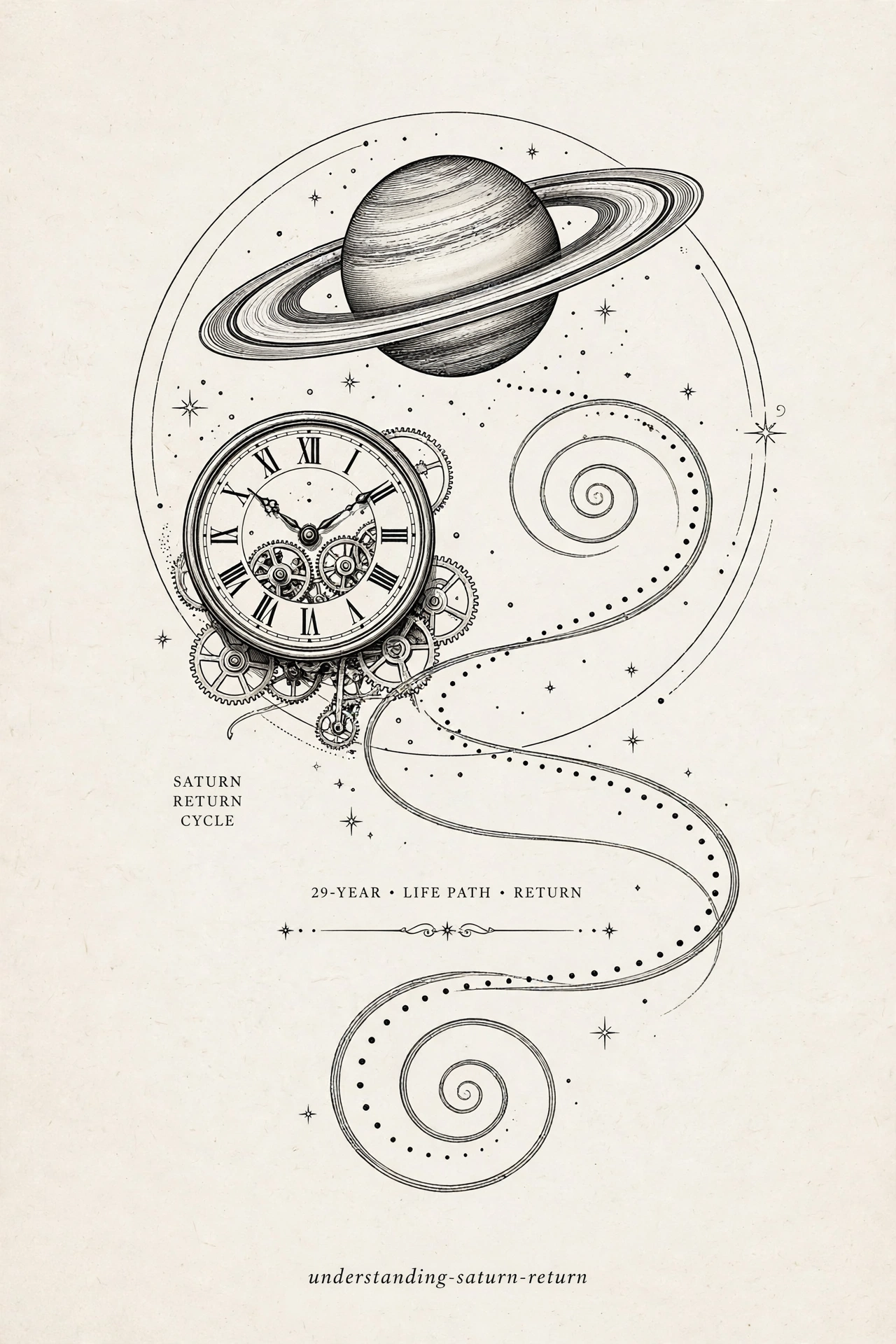
Approximately every 29.5 years, Saturn completes a full orbit in the sky and returns to the position it occupied at the moment of your birth. In astrology, this is called Saturn Return — and it is exactly the astrological equivalent of the experience that has become popular on social media as the “crisis of the twenties.” However, Saturn Return is neither a harbinger of disaster nor merely an internet trend: it is a rare and definitive period when the slowest moving personal planet truly tests the structure of your life.
What is Saturn Return Really?
At the moment of your birth, Saturn was located at a specific sign and degree in the sky — this is your natal Saturn. Saturn takes about 29.5 years to complete its orbit around the Sun; thus, at the end of this period, the actual Saturn in the sky returns to the exact point (with degree precision) of your birth moment. This return moment and the surrounding approximately 2-3 years’ window is known as the “Saturn Return.”
This is not random symbolism, but a real celestial mechanical phenomenon — and it is one of the few significant milestones in astrology that is exactly calculable.
What Does Saturn Represent?
The first requirement for interpreting Saturn correctly is to not see it merely as the “planet of difficulties.” In traditional astrology, Saturn is referred to as the “great teacher” — the planet of discipline, boundaries, responsibility, and time. Wherever it stands in your chart is the area of your life that requires genuine structure, tasks, and long-term responsibilities. It is also associated with authority figures (father, boss, state, institutions), aging, and bodily structures that “harden” like bones/teeth/joints.
The critical point: the limitation that Saturn brings is not punishment but shaping. Success that comes from hard work and commitment is the true reward of Saturn — difficulty is the process of building structure.
First Saturn Return (~29-30 Years): The Beginning of True Adulthood
The first Saturn Return usually occurs at the end of one’s twenties and often brings questions like: Am I truly living my life, or am I living up to others’ expectations? Career, relationships, living situation, and the foundations of your identity are all likely to undergo serious review during this period. Endings of relationships, changing careers, and moving are common in this period — but these are not random losses; they are the separation of things that no longer fit your true structure.
This is the astrological skeleton of the popular cultural narrative known as the “crisis of the twenties”: what feels like a crisis is not actually a temporary struggle, but the transition to true adulthood.
Second Saturn Return (~58-59 Years): Legacy and Wisdom
The second Saturn Return has a different character. The foundational structure has already been established; the question during this period is not “What am I building?” but rather “What am I leaving behind?” Themes of mentorship, legacy, and becoming an authority figure come to the fore in the second half of one’s career. The raw construction of the first return gives way to mastery and transmission in the second return.
Third Saturn Return (~87-88 Years)
This rarely experienced third return is seen as a period summarizing the wisdom of a lifetime, a time when one seeks final reconciliation with life — it is a true “full circle” moment for those who reach this age.
Which House, Which Test?
The life area in which the Saturn Return will be felt depends on which house your natal Saturn is located in:
- 1st house: Identity and self-presentation undergo a serious redefinition.
- 4th house: Responsibility regarding family, home, and roots (e.g., caring for parents, establishing one’s own home) becomes prominent.
- 7th house: Relationships and partnerships go through a serious test of commitment — decisions about marriage or separation intensify during this period.
- 10th house: Career and public identity are directly tested — promotions, career changes, or confrontations with authority.
These are just four examples — the exact house position of Saturn in your natal chart determines precisely where the return will play out.
You Are Not Alone: Other Major Age Milestones
The Saturn Return is just one of the major transformative periods of life that cluster around certain ages. The cycles of outer planets (Uranus, Pluto, Neptune) similarly cluster around specific age intervals:
- ~42-45 years: Uranus makes an exact opposition to its natal position (“Uranus Opposition”) — typically a period known as the “midlife crisis,” where the search for freedom and reinvention intensifies.
- Every ~7 years: As Uranus changes signs, sudden, unexpected breaking points may be triggered during certain phases of life.
This is not a coincidence: while your natal chart remains fixed, the real planets in the sky continue to move — and at certain ages, similar major life themes are triggered almost simultaneously for nearly everyone. The Saturn Return is the most precise and calculable part of this broader “life cycles” map.
Your Natal Saturn Determines the “Tone” of the Return
Two people can experience their Saturn Return at the same age, but their experiences may feel very different — because the Saturn Return amplifies the current condition of Saturn in your natal chart, not imposing the same scenario on everyone. If Saturn in your natal chart receives strong and supportive aspects, the return may feel more like a form of “reaping the rewards of effort” — the things you have patiently built bear fruit. If Saturn was born with challenging aspects, the return may feel more like a reckoning, a delayed confrontation. The difference is not between “good place / bad place” — both are real growth, just through different paths.
Why Does It Feel So “Heavy”?
One reason Saturn Return is talked about so much on social media is that modern life often frames the end of the twenties as still a “period of exploration” — but at this time, Saturn demands real responsibility and structure. This dissonance makes the return feel “heavier” than it actually is. However, Saturn’s demand is actually quite simple: it is time to decide what truly belongs to you and what is borrowed identity.
Common Misunderstanding: “Saturn Return = Catastrophe”
Much of the content circulating online describes the Saturn Return solely in terms of fear. However, the key message emphasized in sources is quite the opposite: the challenges brought by Saturn are necessary for realistic growth and lasting structure. What ends during this period are things that no longer align with your true structure; what is created lays the foundation that will stand for decades. It is much more accurate to read the Saturn Return as a period when “life begins to take you seriously” rather than “a time when life punishes you.”
Calculate Your Saturn Return
To know exactly when your Saturn Return occurs and in which house you will be tested, you need to know the sign, degree, and house position of your natal Saturn. After calculating your free birth chart on AstroMax, you can see the exact position of your Saturn and track when the transiting Saturn will return exactly to your natal Saturn.
Calculate your free birth chart and discover where your Saturn is located.
In Summary
- Saturn Return is a celestial event based on real sky mechanics that repeats approximately every 29.5 years (first: ~29-30, second: ~58-59, third: ~87-88 years).
- Saturn is the “great teacher” — it brings discipline, responsibility, and structure; it is shaping, not punishing.
- The first return is about the transition to true adulthood, the second centers on legacy/wisdom, and the third is themed around reconciliation with life.
- The area of life affected by the return depends on the house position of your natal Saturn.
- The Saturn Return is not alone — it is part of a broader “map of cycles” in life, along with other major age milestones like Uranus’ ~42-45 year opposition.
Bir yanıt yazın
Yorum yapabilmek için oturum açmalısınız.