
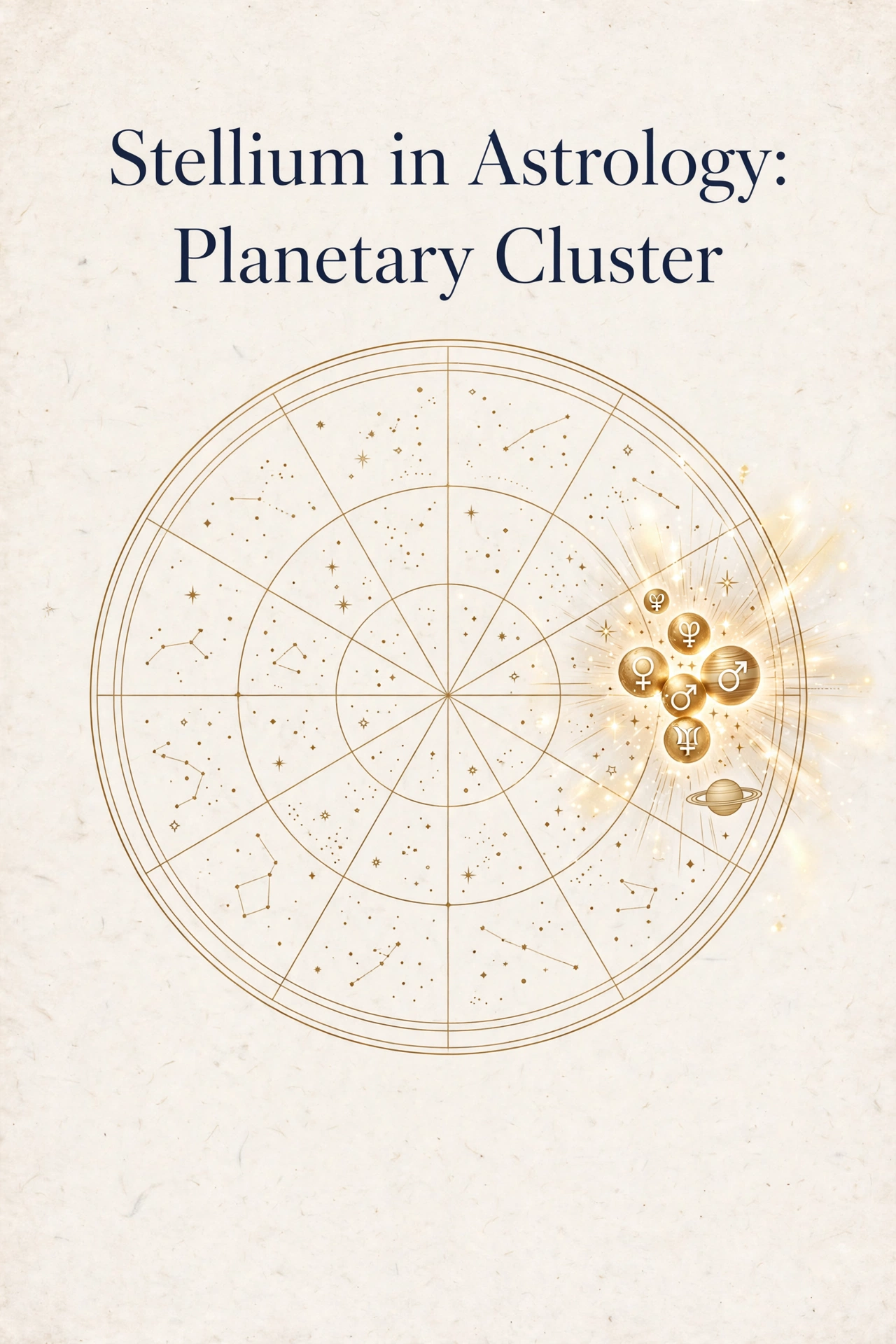
Do you have four or more planets clustered in a sign or house in your chart? Then you have a stellium — one of the most intense, “laser-focused” indicators in astrology. In this article, we explore what a stellium is, how to interpret it, and why it can be both a great gift and a challenging burden.
What is a Stellium?
A stellium (from Latin “star group”) is the concentration of four or more planets in the same sign or house. There are two types: sign stellium (four or more planets in the same sign but in different houses) and house stellium (four or more planets in the same house but in different signs). The effect is even stronger if the planets are both in the same sign and house.
What Energy Does a Stellium Create?
The gathering of so many planets at a single point brings an excessive, almost obsessive focus on the topics of that sign or house — the individual becomes laser-focused on that area, and this energy can overshadow other elements of the chart (even the Sun sign). For example, someone with a Sun in Aquarius but a stellium of four planets in Capricorn may exhibit more of Capricorn’s disciplined, serious nature in daily life than Aquarius’s.
A stellium generally bestows a special talent, deep expertise, or extraordinary work capacity — but there is a price: the intense focus can lead to a narrow “vision” and challenges in compromise. A person with a stellium often operates in an “all or nothing” manner.
How to Interpret a Stellium?
- Sign distribution: Are all the planets in the same sign, or are they spread across two neighboring signs? In the latter case, the minority sign may play a balancing role for the majority’s negative traits.
- Ruling planet: If the ruler of the sign/house where the stellium is located is part of the stellium, the influence is significantly amplified — this planet becomes the key to interpreting the stellium.
- Outer planets: If Uranus, Neptune, or Pluto are part of the stellium, the influence can transcend personal matters and acquire a generational/collective dimension.
- Opposing house/aspect: If there is an opposing planet or empty house to a stellium, it provides the individual with an “exit point” — consciousness of choice. A stellium without opposition can more easily get stuck in its own blocked area.
Example: Famous Stelliums
Examples provided in sources show an interesting pattern: Jack Paar’s stellium of Mars-Sun-Mercury-Jupiter in the 3rd house directed him towards communication/media; Picasso’s stellium in Taurus in the 10th house (ruled by Venus) identified his career with art. The house where the stellium is located typically plays a decisive role in the person’s career or life mission.
Relationship Between Empty Houses and Stellium
Since there are 10 planets and 12 houses, everyone naturally has at least one or two empty houses. For those with stelliums, this emptiness becomes even more apparent — many planets cluster in one house, leaving the other houses relatively empty. This may indicate that the individual chooses to focus clearly on a few main life tasks rather than on worldly distractions in this life.
To see the planet concentrations in your own chart, you can check our chart shape article.
Bir yanıt yazın
Yorum yapabilmek için oturum açmalısınız.