
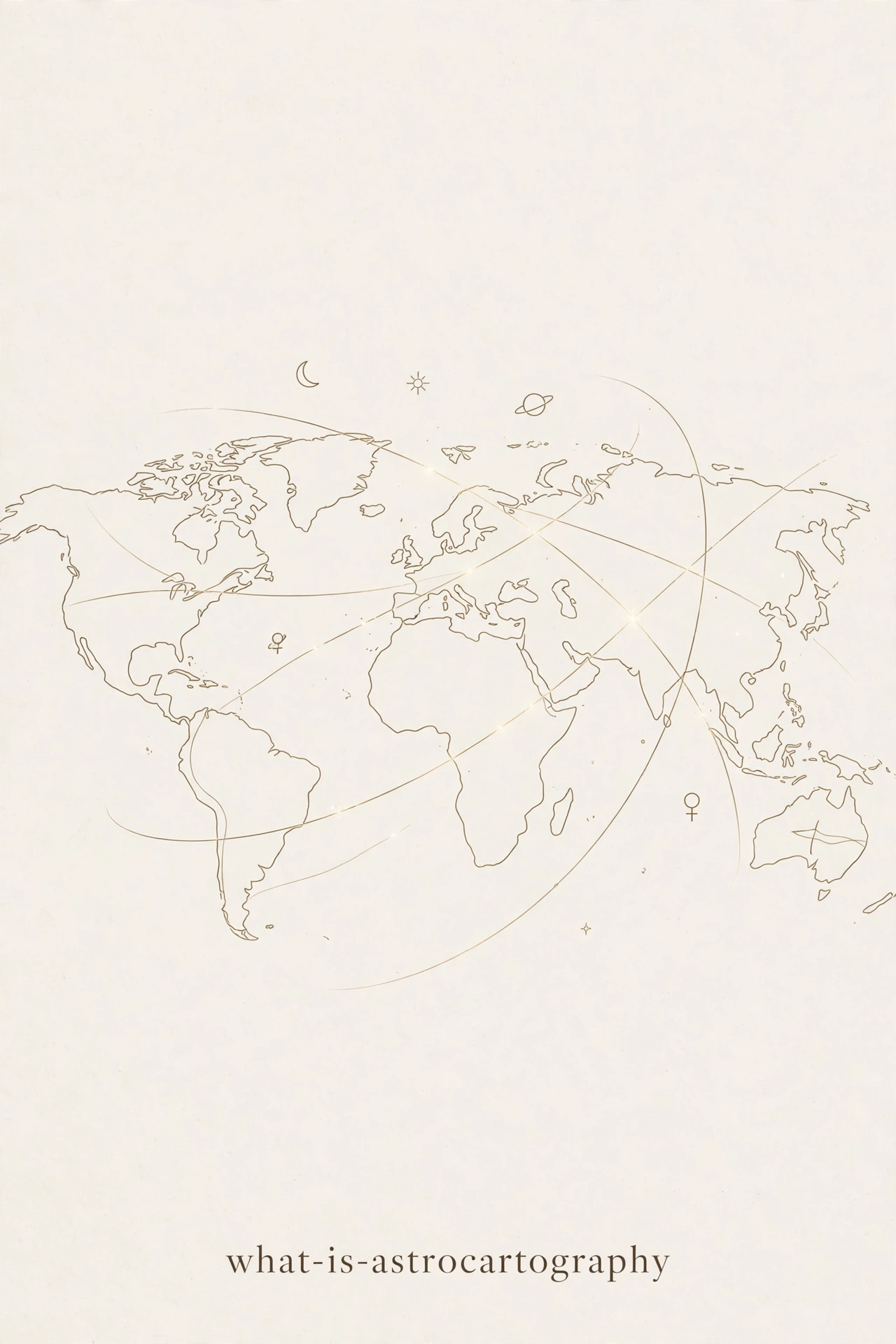
Your birth chart encodes not only when you were born but also how the sky looked at that moment from every point on Earth. This simple yet little-known fact forms the basis of one of astrology’s most practical branches — astrocartography: at the same moment of birth, a planet could be at the top of your chart (MC) in Tokyo, at your rising point (ASC) in Iran, and at your descending point (IC) in the middle of the Atlantic. When these points are connected on a world map, planetary lines emerge that surround you on the globe.
What is Astrocartography, Who Discovered It?
Astrocartography (English Astro*Carto*Graphy, abbreviated ACG) is a technique developed by American astrologer Jim Lewis in the 1970s. Lewis’s idea was simple but revolutionary: your birth chart can be recalculated not only for the place you were born but for anywhere in the world. You may not have been born in Tokyo, but the sky at your moment of birth also becomes a chart when viewed from Tokyo — and your planets sit in different houses and angular positions in that chart.
The critical point is: the positions of planets in the signs and the angles they make with each other never change — this is your core character, and it does not change with relocation. The only thing that changes is the house and angular positions of those planets on the world map — in other words, the themes that a place “amplifies” for you.
Four Lines, Four Meanings
In an astrocartography chart, there are four possible lines for each planet — corresponding to the four angles in your birth chart (Ascendant, Midheaven, Descendant, Imum Coeli). The MC and IC lines run straight down the map, oriented north-south; the ASC and DSC lines, however, are curved.
| Line | Meaning | Arrow Direction |
|---|---|---|
| MC (Midheaven) | Career, recognition, public identity, professional peak | Up — spiritual/public |
| IC (Imum Coeli) | Home, roots, family, inner world, material foundation | Down — physical/private |
| ASC (Ascendant) | Individual emergence, personal initiative, self-expression | East — personal goals |
| DSC (Descendant) | Relationships, partnerships, marriage, collaborations | West — relational |
A word of caution: the arrow directions on the astrocartography chart are read inversely to your birth chart — in the natal wheel, the Ascendant is on the left, but on the world map, the arrow of the Ascendant line points east, or to the right. This is a detail that even experienced chart readers can confuse at first sight.
How to Read a City
Every planetary line crossing a region strengthens the nature of that planet there. There is no permanent “good place / bad place” list — what matters is which planet’s line corresponds to your needs:
- Sun / Jupiter / Saturn MC line: strong candidates for those seeking career and recognition.
- Venus DSC line: known as the “marriage line” in modern astrocartography practice — one of the places where the themes of partnership and love appear the strongest.
- IC lines (especially Moon, Venus): sought after for desire to settle down, start a family, and root.
- Mercury band: favorable for writing, education, sales, and communication work — but the same band can lead to gossip and misunderstandings if used carelessly.
- Mars band: enhances physical energy and competition; ambition and motivation may increase, but potential for tension/conflict also rises in the same band.
So, the question should not be “what happens if I go here?” but rather “what do I want to amplify?” If you are focused on money/gain, looking into regions that strengthen the 2nd house is a good start; if you are focused on settling down/building a home, look for regions that strengthen the 4th house; if you are career-focused, look for regions that strengthen the 10th house.
The Most Common Mistake: Detaching the Line from the Natal Chart
This is the biggest trap that much of the content circulating about astrocartography online falls into: seeing an MC line and saying directly, “your career shines here.” However, the line amplifies the state of the planet in your birth chart — both the good and the challenging.
If Saturn is receiving challenging aspects in your birth chart, a city on Saturn’s MC line does not automatically promise you a “career paradise” — it becomes more of a testing ground: you may rise to the top, but with an ongoing struggle against institutions, authority, and discipline. (A common example in astrology history: in a city on the MC line of Saturn in Marie Curie’s birth chart, she reached her scientific peak but struggled for years for institutional recognition.) Always ask yourself before making beneficial/malefic distinctions: how is this planet behaving in my birth chart?
Intersection Points (Parans) — Where Two Lines Meet
Latitudes where two different planetary lines intersect on the world map create a third theme all on their own. For example, a region where Jupiter and Uranus lines intersect may carry a “lucky and liberating” composite energy. These intersection points (also known as “parans” in astrology) leave a subtle influence not only exactly at the intersecting longitude but also at other points along that latitude of the Earth.
Practical rule: the closer you are to the line (roughly within a few hundred kilometers), the more fully you feel the effect; as you move away, it fades. A wide region between two powerful lines may share qualities from both.
A note for balance: some intersections (for example, a region where Pluto is on the MC while Mars is on the ASC) may be associated with strong, even crisis-inducing events. Such intersections do not automatically promise catastrophe, but they should be evaluated carefully — and again, based on the true condition of those planets in your natal chart.
Love Lines: The Map for “Where Will I Find Love?”
This is one of the most curious — and commonly misunderstood — applications of astrocartography. In modern practice, several lines are read specifically as “relationship bands”:
- Venus-DSC: commonly referred to as the “marriage line.” It is said that partners encountered on or born along this line are more likely to have happy, lasting relationships.
- Venus-MC: carries a nuance of a more spiritual, nurturing partnership — partnerships intertwine with career/public life.
- Venus-IC — “the best and most dangerous line”: an interesting warning comes into play here. This line makes life so easy, offering such comfortable and cozy partnerships that personal effort and spiritual growth can come to a standstill — a kind of “comfort trap.” Venus lines generally promote habit and stagnation, not novelty and growth.
- DSC lines (not just Venus): Those of the Moon, Jupiter, and Sun’s DSC lines are also read as highlighting all kinds of partnerships (romantic, professional, social).
The same rule applies here: a line being “good” is not guaranteed. Which house Venus rules in your birth chart and what aspects it receives will determine how the line is actually experienced — for instance, even a “good-looking” line from Venus ruling the 8th or 12th house may unexpectedly yield mixed results.
And timing comes into play here too: visiting a city on a love line precisely when your progressed Venus or Sun activates relationship themes is the mechanism underlying the commonly told stories in astrology of “chance encounters” or meeting on the road.
A Curious Note: The Signs of Cities
A cultural by-product of astrocartography is the symbolic assignment of a zodiac sign to certain cities/countries throughout history — for example, Venice is traditionally associated with Libra. These “city-sign” pairings are not scientific calculations but rather layers of cultural/historical observation; they provide a colorful context when considering why a city may feel like it has a certain “personality”.
Local Space – Selecting Direction, Not City
A lesser-known sibling of astrocartography is the Local Space technique. While ACG tells you “which city to go to,” Local Space maps planet energies as directions from your birthplace — for example, “your northwest direction strengthens your Venus energy.” If you are thinking about which direction to plan your home/office/vacation within your city rather than selecting a new country, this layer is more precise.
Astrocartography Chooses Location, Not Time
The final and perhaps most critical distinction: astrocartography shows you where to go, not when to go. Timing is a completely separate technical area — transits, progressions, solar returns. The strongest results appear when the two come together: going to a city on the right line during the correct timing window (e.g., during a period when the progressed Venus/Sun is activating your relationship themes).
An interesting observation: in astrology practice, stories of a timely connection bringing people together “by chance” in a distant city they won’t return to are often told — age is not a barrier to this. This is what makes astrocartography not merely a “relocation map” but a “map of what you may encounter in which corner of your life.”
See Your Own Astrocartography Chart
Every concept in this article — lines, intersections, house emphases — should not remain theoretical. After calculating your birth chart on AstroMax, you can view your own planetary lines interactively on a 3D globe with the Astrocartography tool on your chart results page, discovering which city strengthens which planet for you.
Calculate your free birth chart and try the Astrocartography tool.
In Summary
- Astrocartography is a technique that recalculates your birth chart for every point on Earth (Jim Lewis, 1970s).
- Your planets and the aspects between them do not change — only their house/angle positions, which amplify a theme of a place, change.
- The four lines (MC/IC/ASC/DSC) correspond to four different areas of life.
- Always consider the planet’s natal state when reading a line — there is no such thing as a “good/bad place”, only an “amplifying theme”.
- Venus-DSC is known as the “marriage line”, but even lines that look like “the most comfortable” like Venus-IC can sometimes be a comfort trap.
- Reading location (ACG) together with timing (transits/progressions) completes the picture.
Bir yanıt yazın
Yorum yapabilmek için oturum açmalısınız.